
First Stop: Dijon
The Unfinished Journey
Home | edition Nº 1: What is it about trains that fascinates us so much? | first stop: dijon | The Unfinished Journey
By Mairi Larroque| 2025
The history of railways is full of memorable episodes, some shrouded in mystery. One of the most remarkable is the story of Louis Le Prince: the disappearance of a man who was on the verge of presenting an invention that could transform the way we capture and represent reality.
Dijon
On the afternoon of Tuesday, September 16, 1890, French artist and inventor Louis Le Prince said goodbye to his brother Albert and his nephews on the platform at Dijon station and boarded an express train bound for Paris. He never arrived. He was supposed to meet friends there before continuing on to England. His plan included a brief stop in London, a detour to Leeds to collect his belongings, and finally a journey to Liverpool to catch a ship back to New York, where he had been living with his family since the early 1880s.
The police investigation that followed his disappearance found no trace of him or his luggage, and no witnesses could confirm seeing him on the train or anywhere along the route. Only his brother and nephews testified to seeing him depart. Seven years later, authorities officially declared him dead — without ever finding a body or clarifying the circumstances of his disappearance — leaving open a series of questions that, to this day, remain unanswered.
What happened to Louis Le Prince? At what point along the journey did he vanish? Did he even board the train? Was it kidnapping, murder, or a deliberate disappearance? The truth remains an enigma.
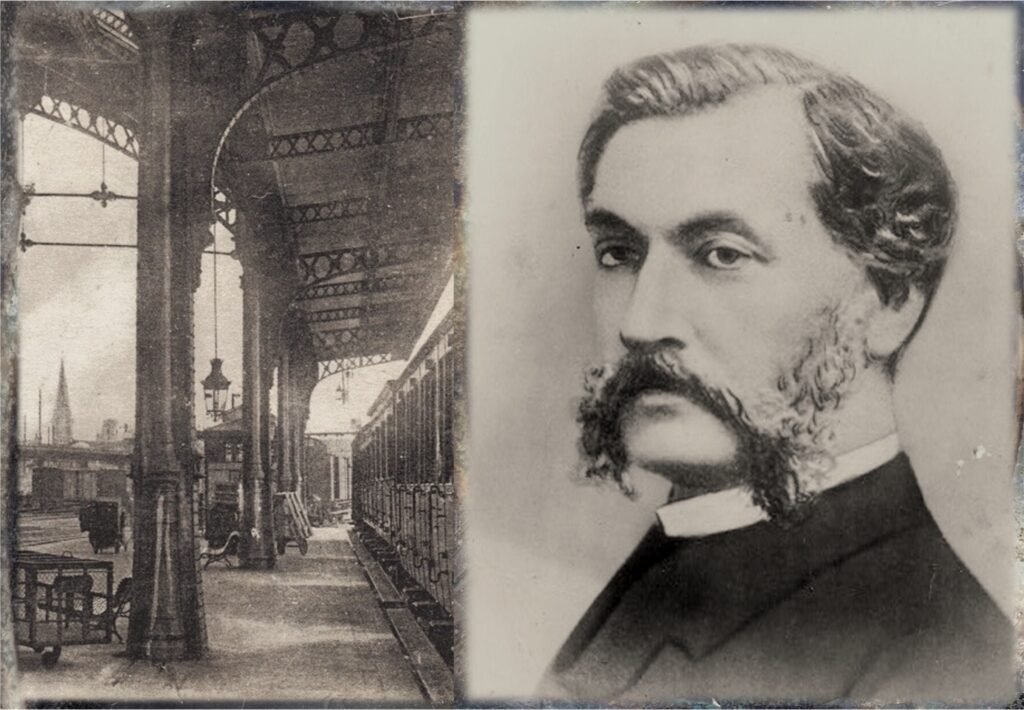
The police investigation found no trace of him, his luggage, or any witness who saw him board the train.
Le Prince the Visionary
In the mid-1880s, while working in New York as a manager overseeing the creation of panoramas — large-scale installations that offered audiences an immersive experience — Le Prince had a vision: to bring movement into his spectacles, heightening the sense of reality.
With that goal, he began exploring the technologies of his time and eventually designed his own device. His first prototype featured sixteen lenses, a complex mechanism riddled with synchronization problems. Despite its flaws, it captured the first moving images — imperfect, yet enough to convince Le Prince to give himself body and soul to perfecting his invention.
Determined to succeed, he returned to Leeds in 1887 — the city where he had lived before moving to New York — because it offered the resources and environment he needed. After months of experimentation, he built a new device that solved many of the previous model’s flaws. His most important innovation was simplification: reducing sixteen lenses to just one.
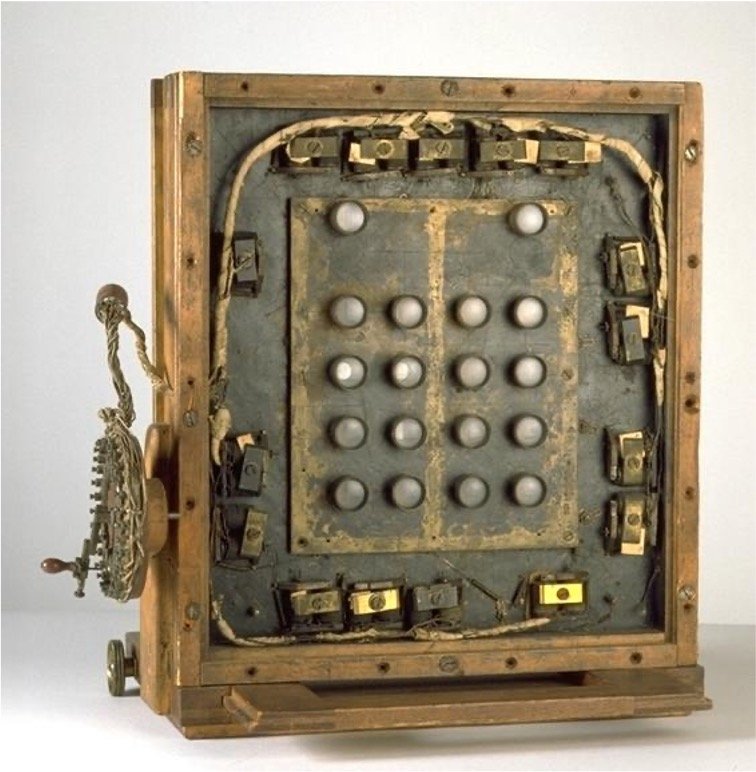
The first movie camera
Le Prince patented a 16-lens camera in 1886 and later refined it to a single lens — years before Edison filed his patents.
In October 1888, he tested his device in a familiar, intimate setting: the garden of his in-laws’ house in Leeds, during a small family gathering. He filmed his son Adolphe, his parents-in-law Joseph and Sarah Whitley, and family friend Annie Hartley walking and turning in circles. The footage was extraordinary. Those few seconds confirmed that his invention worked. Recovered and restored years later, it would become the Roundhay Garden Scene, widely recognized as the first film in history.
Roundhay Garden Scene (1888), filmed by Louis Le Prince — years before Edison and the Lumières.
Le Prince spent the following months refining his invention, experimenting, recording new scenes, and perfecting every component. By 1889, confident in his device, he planned to present it to the world. He set his departure for late 1890, while attending to technical details, personal matters, and preparing a venue in New York for his invention. Everything seemed ready for him to secure his place in history.
In September 1890, just before returning to the United States, he made a brief trip to Dijon to visit his family and settle some matters related to his mother’s estate. It was then that the unexpected happened: he vanished without a trace while boarding the express to Paris.
Had he presented his invention in New York, Louis Le Prince would be remembered today as the true father of cinema. But his sudden disappearance cleared the path for others to claim the glory: Thomas Alva Edison and the Lumière brothers.
During the seven years following his disappearance, his family was legally bound, unable to act on his behalf or promote his invention. Meanwhile, Edison — celebrated for his genius, his ruthless patent strategy, and his documented talent for stealing other people’s ideas — registered the kinetograph and kinetoscope in 1891, and by 1893 was successfully marketing his inventions, presenting himself as the pioneer of moving images.
The coup de grâce came from Paris. On December 28, 1895, the Lumière brothers publicly screened their cinematograph at the Grand Café. That moment not only inaugurated cinema as we know it, but began a new technological era — one that excluded Le Prince, its true precursor.
When Cinema Met the Train
Following the success of the cinematograph in Paris, the Lumières presented it in Lyon in January 1896. The screening featured a film that would become iconic: a single take of a locomotive emerging from the distance and heading straight for the station. Each second, its figure grew larger, and just as it seemed about to burst from the screen, the audience jumped in their seats, overwhelmed by a visual effect that made the train feel as if it were charging at them. For the first time, the moving image blurred the line between reality and representation.
The innovative framing — camera positioned diagonally on the platform — the shock it produced, and the visual richness of a single static shot laid the foundation for cinematic language. The piece would be remembered as L’Arrivée d’un train en gare de La Ciotat — The Arrival of a Train at La Ciotat Station.
Viewers jumped from their seats — convinced the locomotive was heading straight at them. It was 1896. It was the first time a moving image blurred the line between reality and representation.
Its impact went beyond awe: it sparked the imagination of future filmmakers, including illusionist Georges Méliès, who was among the first audiences in Paris. Méliès was so captivated that he integrated the arriving train as a striking visual device in his own films, such as Le Voyage à travers l’impossible (1904) and Tunnel sous la Manche (1907).
L’Arrivée d’un train… unintentionally cemented one of modernity’s most potent associations: train and cinema. Both symbolized an era fascinated by technological progress, speed, and the illusion of mastering time and space. Cinema captured motion; the train embodied it. Cinema opened windows to other worlds; the train offered journeys to new horizons. Two great nineteenth–century inventions converged — and the name of Louis Le Prince quietly faded between them.
Paradoxically, Le Prince’s disappearance played out on the railway as its final stage. The irony is almost cruel: for him, the train marked not only the end of his life, but the impossibility of entering the history of cinema; while for the Lumières, the locomotive became a gateway to lasting fame.
Painting Speed
The fascination with capturing trains in motion did not begin with the Lumières. Decades earlier, long before the cinematograph existed, English painter J.M.W. Turner anticipated with his brush what they would later capture with the camera: a locomotive barreling straight toward the viewer.
His painting, Rain, Steam, and Speed – The Great Western Railway, presented at the Royal Academy in 1844, is considered the first major pictorial representation of a railway, foreshadowing modernity’s obsession with speed and machinery.
Through a misty atmosphere, a dark locomotive crosses a reddish bridge — the new Maidenhead Bridge, inaugurated in 1839, an engineering feat of its time. Turner, an avowed admirer of technological progress, did not merely document contemporary advances; he made the train and bridge central characters in his composition.
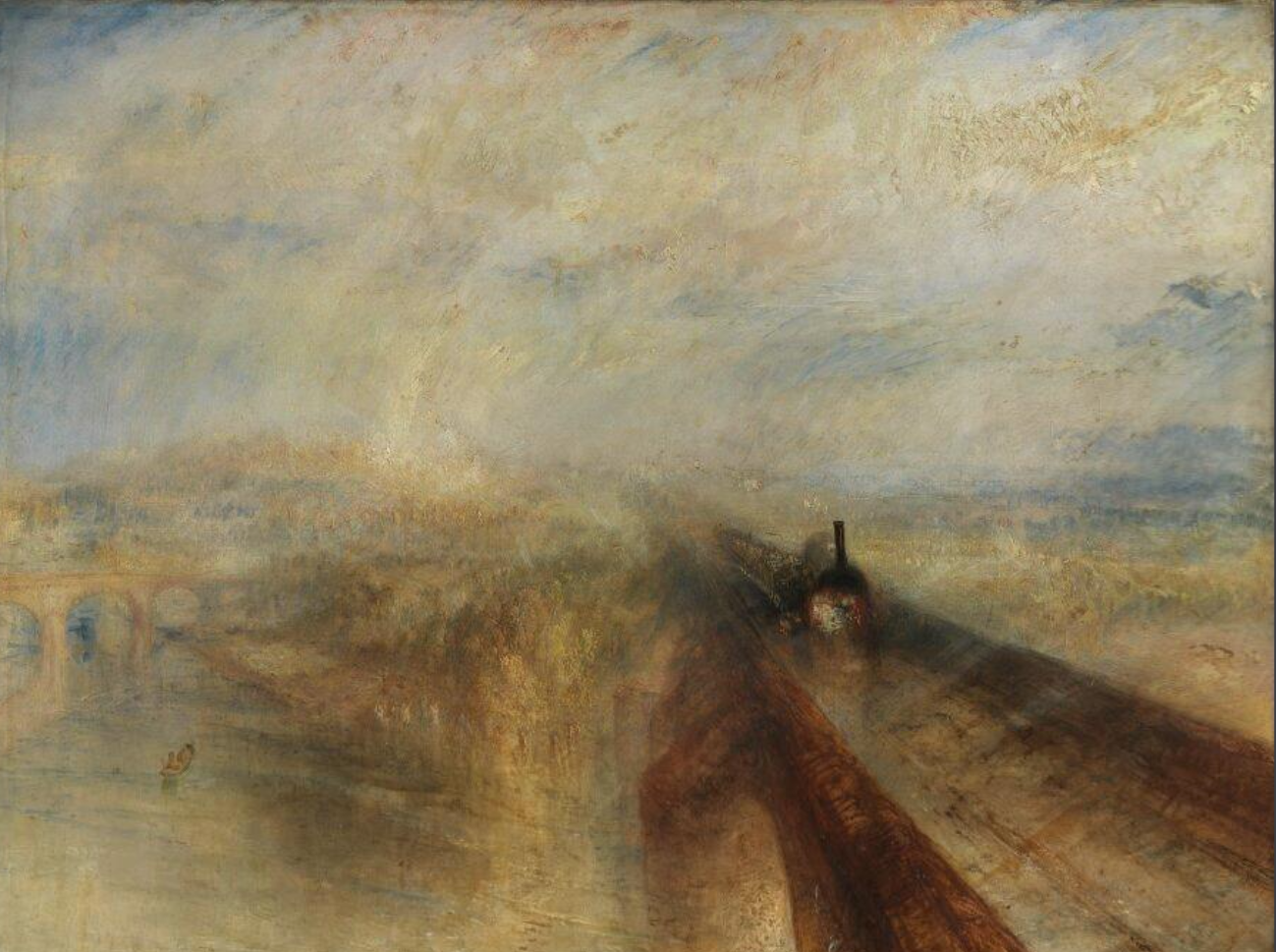
The first major pictorial representation of a railway.
To convey speed, Turner painted an almost abstract landscape, characteristic of his style, with blurred outlines and minimal detail. Against this ethereal backdrop, the locomotive asserts itself as a tangible presence, creating a tension between concrete form and atmospheric impression. Its trajectory cuts diagonally from the canvas center to the edge.
The work amazed contemporary audiences. Its innovative perspective gave the machine a striking sense of motion, suggesting that it might spill out of the painting. At the time, the railway industry, only fourteen years old, was still new and expanding at a dizzying pace.
With Rain, Steam, and Speed, Turner captured not only the train’s motion but its transformative power over the surrounding environment. Tracks, bridges, and tunnels carved paths through nineteenth-century landscapes, sometimes violently, reshaping geography itself.
Both Turner and the Lumières, each in his own medium, understood the profound fascination trains inspired in the nineteenth-century imagination. It was not a single, unambiguous feeling: awe at progress coexisted with unease at the irreversible impact of machines on society and nature.
Catch Me Who Can: The Spectacle That Started It All
Before revolutionizing land transport, the locomotive was a modest machine born in Britain’s mining heartland. Its story began with engineer Richard Trevithick, who realized that his self-propelled steam engine could do more than haul coal wagons. Like Louis Le Prince decades later, Trevithick understood the immense potential of his invention and sought to present it grandly. He chose London and staged a spectacle with a provocative name: Catch Me Who Can. For the first time, this machine — not yet called a locomotive — entered the collective imagination.
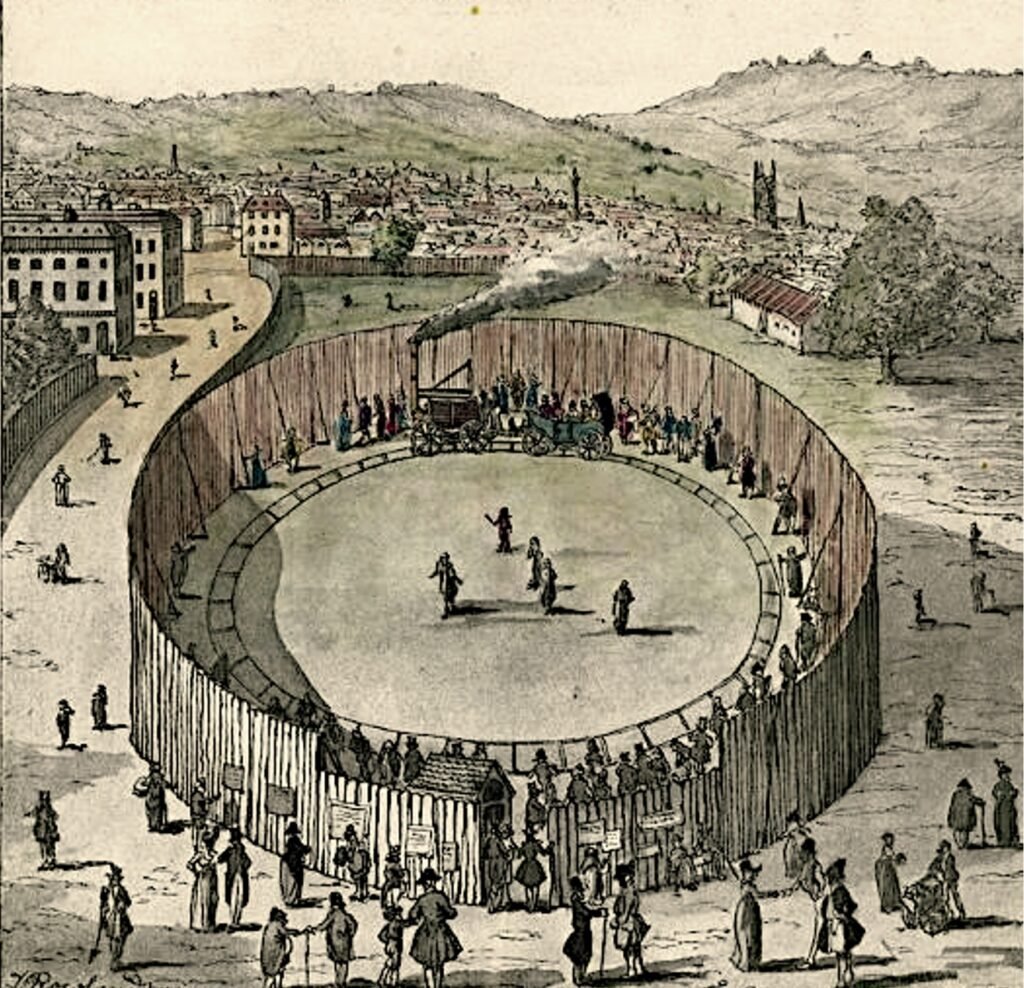
Trevithick and Le Prince shared a fundamental ambition: mastering movement. Trevithick generated it, transforming a stationary steam engine into a self-propelled vehicle. Le Prince captured it, combining photography with a mechanism designed to bring images to life. Both were pioneers, and both recognized that technical achievement alone was not enough— the public had to be captivated.
Trevithick achieved recognition among peers. Le Prince, however, remained largely unknown. When he mysteriously vanished on a train —a distant echo of the very machine Trevithick had once dreamed of setting in motion— the opportunity to present his invention, develop it, and secure his place in history was lost. His fate sank into mystery, and for decades, into oblivion.
And what became of Catch Me Who Can? Did it enthrall London audiences? Did it overcome the technical and economic hurdles of its time?
The answers await at the next stop: London.
Editorial
First Stop: Dijon
The Unfinished Journey
Third Stop: Killingworth
Vorwäsrt!
Fourth Stop: Liverpool
The dawn of the railway age
Fifth Stop: New York
Coming soon
Don't miss anything!
Subscribe and get the latest updates.
Global ideas, stories connected