
Second Stop: London.
Catch Me Who Can
Home | edition Nº 1: What is it about trains that fascinates us so much? | Second Stop: London. | Catch Me Who Can
Por Mairi Larroque | 2025
At this stop, we travel to London, 1808, to witness a historic moment: the first time passengers ever boarded what we would later call a locomotive. Of course, they had no idea. That strange, noisy machine didn’t even have that name yet. For them, it was simply a novel contraption, part of a spectacle called Catch Me Who Can.
London
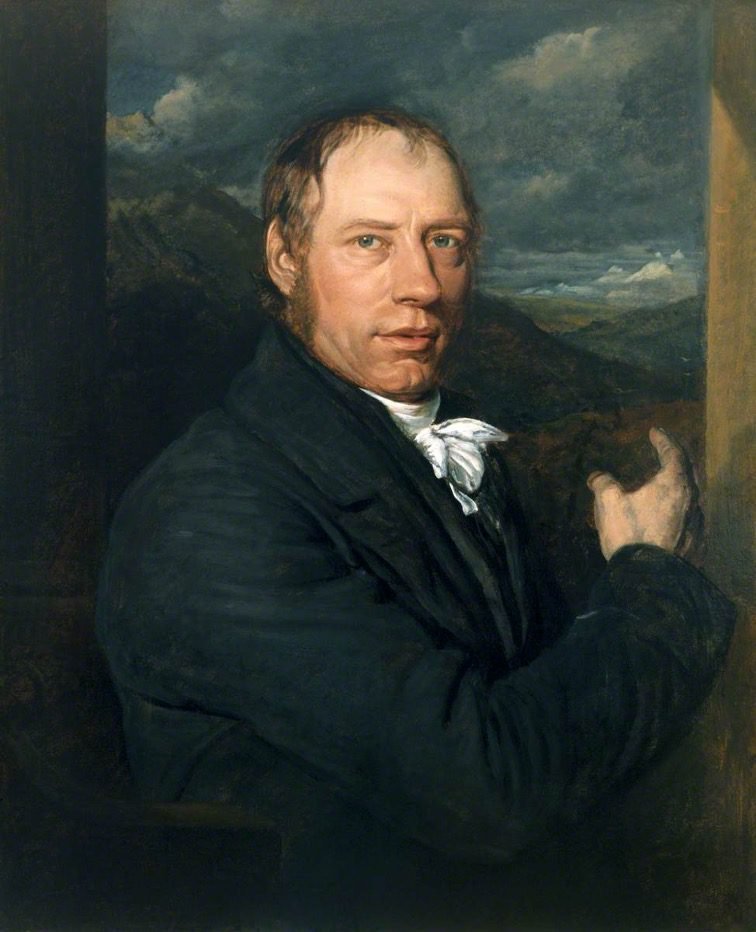
In the summer of 1808, in Bloomsbury, on a plot of land near Euston Square, a circular wooden enclosure was erected, which would become the stage for a new spectacle. Soon, columns of steam began to rise, along with a low, metallic sound, difficult to make sense of. No one knew exactly what was inside. In the days leading up to the opening, a rumor began to spread: an artifact capable of moving on its own — without horses, without oxen, without any animal force to pull it — would be presented to the public. How was that possible? Its inventor, the engineer Richard Trevithick (1771–1833), claimed it was a steam-powered machine that could be faster than any carriage.
When tickets went on sale, the curious rushed to see what the spectacle — advertised under the name Catch Me Who Can — had to offer, though both the public and the press preferred to call it the Steam Circus. For one shilling, one could take a few turns aboard the machine and experience firsthand the unprecedented sensation of mechanical speed. The ticket featured a drawing of the machine alongside a defiant phrase: “Mechanical power subduing animal speed.”
— What if it explodes? They say steam boilers burst without warning.
— A shilling for a few turns in a circle. Let’s see if it’s worth it.
— It must be a trick. Something has to be pulling it from the inside.
Upon entering the enclosure, visitors saw an iron machine far more complex than the image on the ticket, to which a rudimentary carriage was attached, where passengers took their seats. As it set off, the engine’s roar turned into rhythmic chuffing, accompanied by a sharp whistle each time steam was released. The clatter of the wheels on the cast-iron rails mixed with exclamations of surprise, admiration, and fear, along with murmurs and nervous laughter. The speed did not quite match what had been promised, but riding a machine that truly moved on its own was a unique experience.
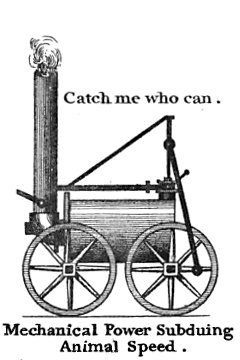
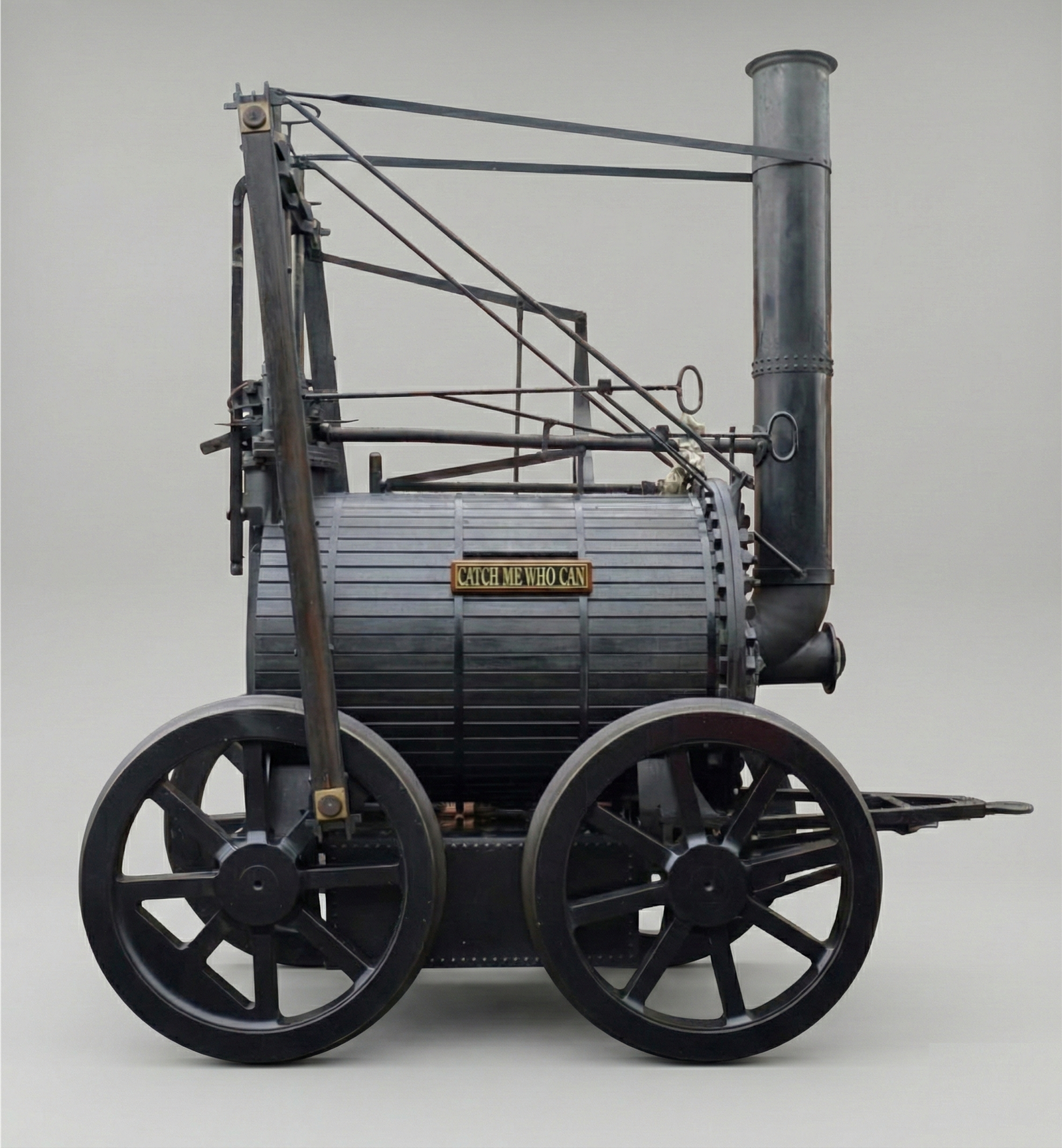
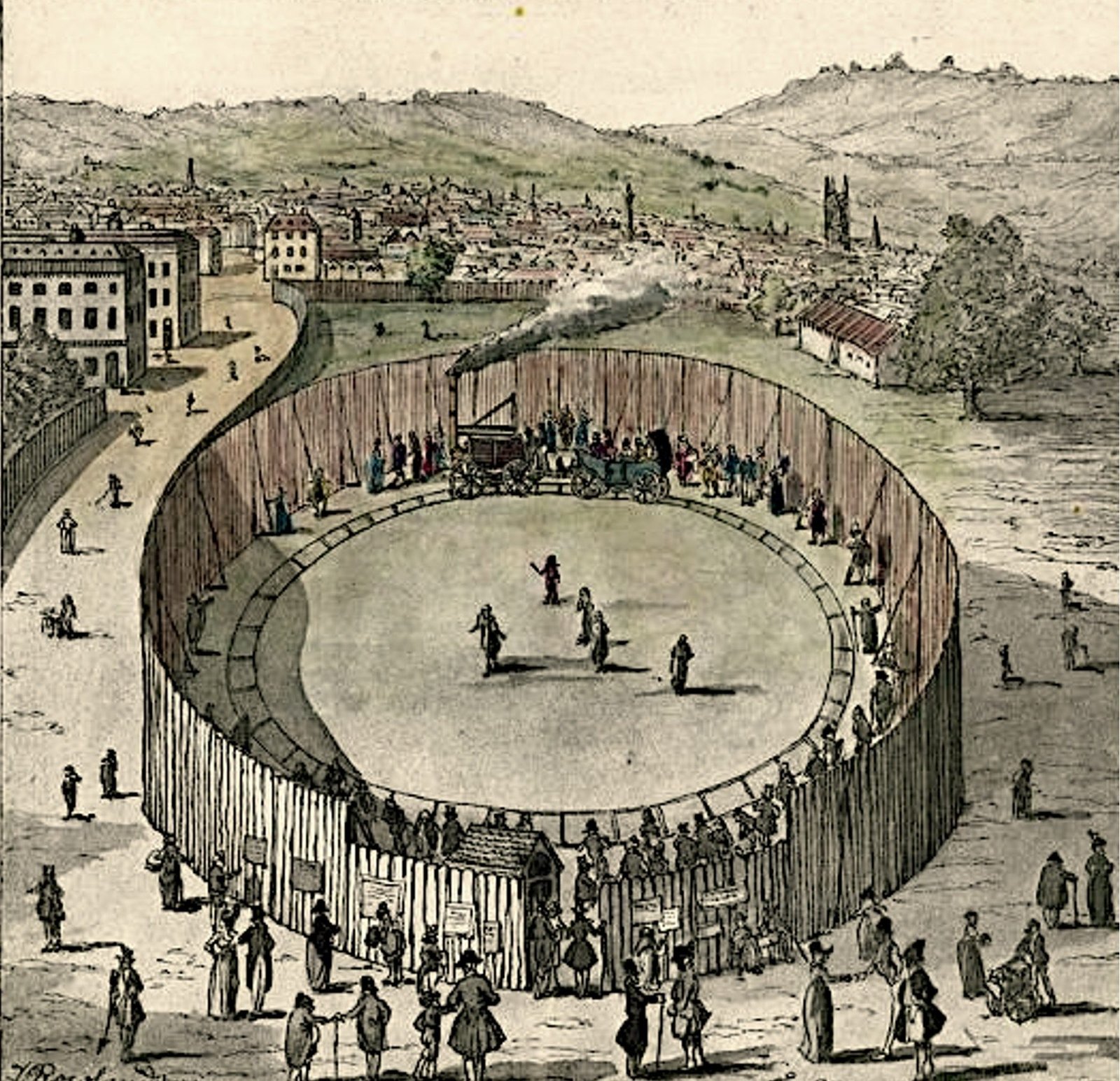
In its first performances, Trevithick’s machine operated without incident. For some, it was a fabulous, almost magical trick; and although most were fascinated by the experience, a few skeptics saw it as a curiosity with no practical use and doubted its reliability compared to horses.
However, problems soon began to emerge: the rails began to give way under the continuous passage of the heavy machine and its carriage, forcing the ride to stop for adjustments. The interruptions became increasingly frequent and gradually dampened public interest. Initial enthusiasm gave way to skepticism. Finally, a critical failure during one of the performances brought the spectacle to a close.
It was a hard blow for Richard Trevithick. He had high expectations for his London venture. It was a spectacle designed to impress the public and attract investors. The machine was presented not only as a technological advancement, but as a practical and commercially viable innovation. The format of the show was part of that strategy: to sell the experience in order to secure funding for the invention.
The premature closure frustrated that objective and drove away any interest from potential investors. Trevithick was left in debt, with his reputation damaged and his financial situation precarious.
But why did he stake everything on that machine? What led him to imagine that he could change land transport with his Catch Me Who Can?
The Cornish Boy
In the late eighteenth century, a young Richard Trevithick — talented and ambitious — was beginning his training as an engineer in the mines of his home region, Cornwall, in the southwest of England, working with steam engines.
In 1794, interested in advances in steam technology that could improve the performance of mining machinery, he went to visit the engineer William Murdoch in Redruth. Murdoch was one of the leading engineers at Boulton & Watt, but he had developed on his own, in the mid-1780s, something Trevithick wanted to see with his own eyes: a small three-wheeled carriage capable of moving by itself, powered by an engine running on “strong steam,” that is, high-pressure steam without a condenser.
Trevithick was impressed to see the model moving autonomously around the inventor’s room. That mechanism demonstrated that steam could be used at much higher pressures than those allowed under James Watt’s design, opening up two concrete possibilities: more compact and powerful engines, and vehicles capable of moving under their own power.
But those possibilities ran into a wall. Many engineers considered high-pressure operation too dangerous, and although Murdoch’s experiment worked, scaling that principle up to larger machines was considered impractical. The main opponent was James Watt himself, whose authority in the field was unquestionable. His innovations in steam engines were fundamental to industrial development. Alongside his partner Matthew Boulton, Watt not only questioned the safety of high pressure, but also saw it as a direct threat to the business model they had consolidated over decades. In addition, he distrusted the application of steam power to self-propelled vehicles.
Murdoch, who worked for them, had little opportunity to take his invention further. Even so, he continued experimenting in private with an idea that challenged Watt’s framework: high-pressure engines, more compact and with potential for locomotion. And it was precisely that combination of power and lightness that interested Trevithick.
Three years later, around 1797, Trevithick settled in Redruth for work and took up residence in a house adjacent to William Murdoch’s. That proximity allowed him to exchange ideas and discuss concepts that moved on the edge of what was considered acceptable, and to observe closely how an engineer who had reached the limits of his employer’s tolerance thought and worked. It was during this period that Trevithick began developing his first prototypes of high-pressure steam engines, determined to bring those ideas into a real-world environment: the mines.
By 1799 he had completed a functional engine for mining use. It was more compact and lighter than Watt’s engines, could be installed in confined spaces, and was easier to transport. Soon, several mines in the region began to adopt it, despite the strong opposition of Watt and Boulton.
That discreet but decisive success opened the way for him to experiment in the direction of steam locomotion and to build his first functional vehicle. By 1801 it was ready. He would test it on Christmas Eve, in the streets of Camborne.
When the Demon Took to the Streets
On December 24, 1801, the residents of Camborne, a mining and industrial town in the county of Cornwall, were left astonished as they watched an unusual vehicle make its way up Camborne Hill. It moved without any animal pulling it and carried six men on board. It was a noisy iron contraption that spat steam through a chimney. “But what is that?” “It looks like a demon!” “Ye s— a demon that puffs and snorts,” the startled passersby murmured. At the controls was one of the mine engineers, Richard Trevithick. From the small cab, he waved with a smile, watching as his invention spread bewilderment and curiosity in its wake.
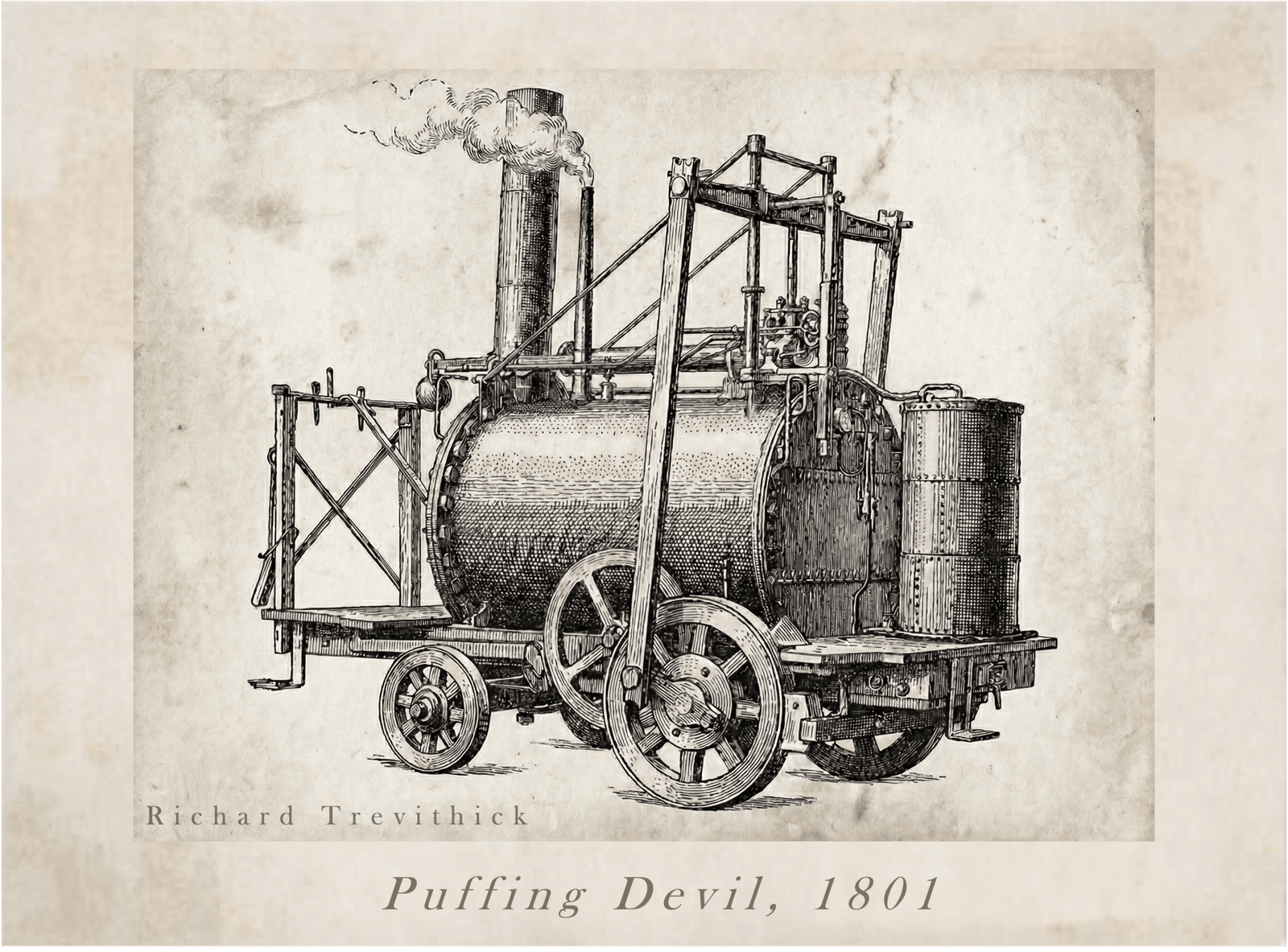
Over the following days, Trevithick continued to exhibit the Puffing Devil, as it came to be known, through the streets of Camborne. But on December 28, while passing over a ditch, the machine broke down. Trevithick and his companions then decided to stop at the Fountain Inn to eat and drink, leaving the machine sheltered in a nearby shed, without shutting it down and with no one watching the boiler.
The oversight proved costly: the water evaporated, the engine overheated, and it began to catch fire. By the time Trevithick realized what was happening, it was already too late to save his invention. It was an unfortunate event that called his success into question. But the accident, far from discouraging him, served as a lesson, as he knew it had been the result of human error, not a failure in the operation of his machine.
The brief life of the Puffing Devil had shown Trevithick that self-propelled vehicles were indeed possible. The accident had been the result of human error, not a failure of the machine itself, and with that conviction he set to work on a new project, partnering with his cousin Andrew Vivian. In 1802, they secured a patent for their high-pressure steam engine, and by the following year they had a new prototype ready. This time, the place chosen for its presentation would be London.
Chaos in the City
The partners named the new prototype the London Steam Carriage. They drove it through the congested streets of the city center, convinced that people would be impressed by the sight of a modern carriage that could move without horses. They succeeded, though not in the way they had expected. Far from appearing imposing and elegant, the carriage was perceived as cumbersome and extravagant. The noise of the engine, the steam, and the smell of oil and coal not only unsettled passersby, but also frightened the horses, causing moments of confusion and minor disturbances in the traffic, as well as damage to the rudimentary streets.
In the demonstrations that followed, they failed to improve the initial impression; on the contrary, the public reaction— a mixture of unease, distrust, and rejection — grew stronger. For most people, the vehicle, although ingenious, did not seem suitable for the narrow and crowded streets of the city, which were difficult to navigate even for conventional carriages.
The venture came to an end when Trevithick and Vivian lost control and crashed into the railings of a house. With that accident, any commercial interest in the London Steam Carriage, if it existed at all, vanished. No investor saw it as viable to risk capital on a machine that was costly to produce, unreliable, and clearly rejected by the public.
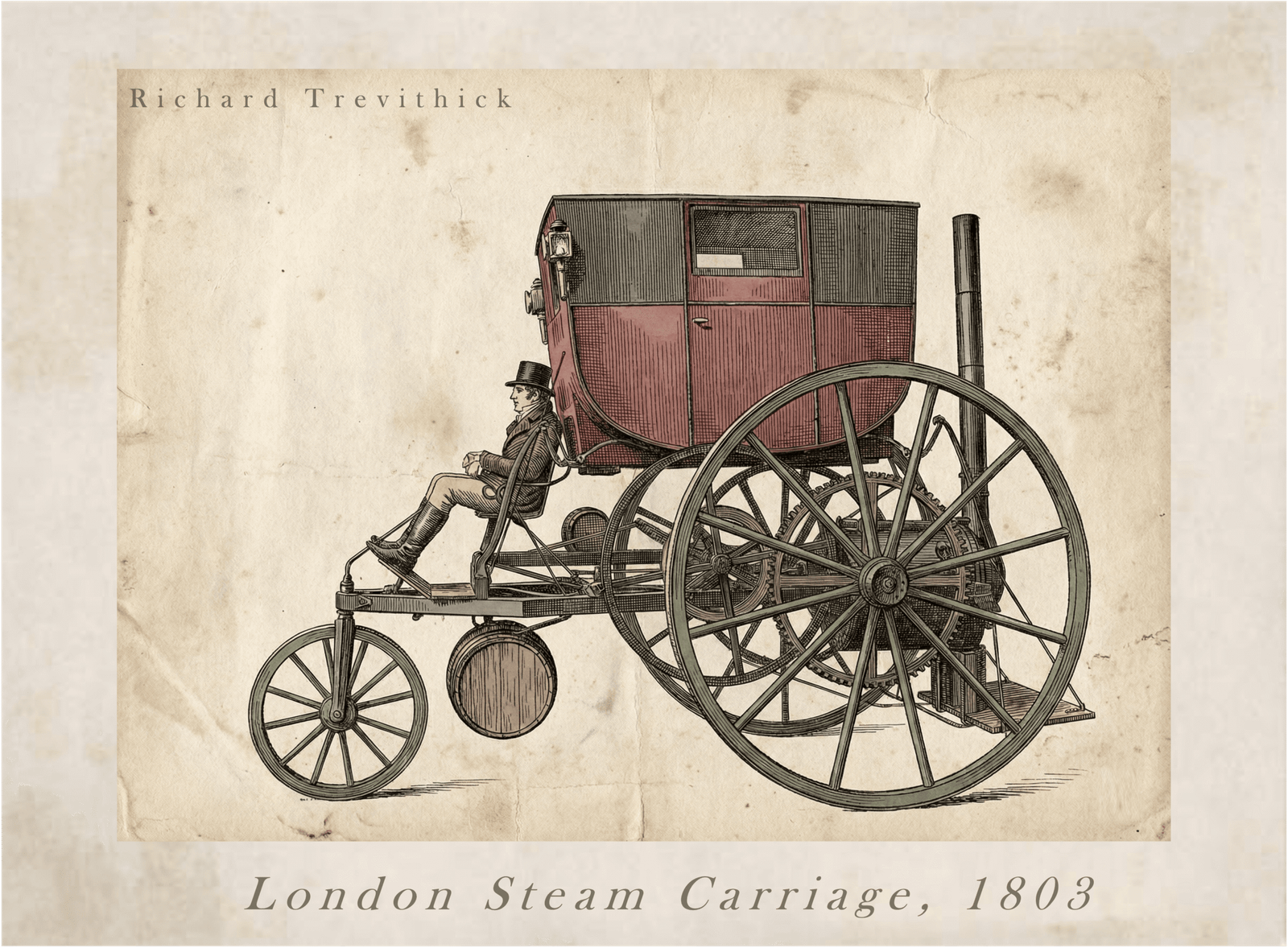
It was a disappointing outcome that did not leave Trevithick in a strong position. However, the worst was yet to come. Months later, one of the stationary high-pressure engines he had managed to commercialize, installed in a mine in Greenwich, exploded due to the negligence of the operator in charge of overseeing it. The accident caused four deaths and several injuries, fueling the criticism of those who already distrusted high-pressure steam. Trevithick’s reputation, already weakened by the London failure, was seriously damaged.
However, at the end of 1803, an unexpected opportunity arose that could restore his standing.
The Penydarren Wager
Samuel Homfray, a businessman and one of the principal partners of the Penydarren ironworks in Wales, had followed Trevithick’s new steam engine with interest and saw considerable potential in his proposal, despite the London failure. He was convinced that high-pressure engines would give him a significant competitive advantage over his rivals. In May 1803, he contacted Trevithick and Vivian and proposed buying half of the patent they had registered the previous year. Homfray was not interested in developing the self-propelled carriage. His focus was on installing stationary engines at his ironworks and marketing them to other mines. The partners accepted.
After the Greenwich accident in September, Trevithick joined Homfray’s ironworks as a general engineer. Towards the end of the year, Homfray set him a challenge: to adapt the machine so that it could haul heavy loads along the rails already used by horse-drawn wagons. Although the immediate motive behind the proposal was to win a wager Homfray had made with one of his main rivals, the iron magnate Richard Crawshay, he was also seeking a way to reduce the cost of transporting iron, and steam locomotion presented a viable alternative. Crawshay distrusted high-pressure steam engines and did not see the potential that Homfray so strongly advocated. To settle the matter, they placed a wager of five hundred guineas. The challenge was to prove that one of Homfray’s machines could haul ten tons of iron from Penydarren to the Glamorganshire Canal, nearly fifteen kilometres.
On February 21, 1804, Trevithick had the machine ready. The engine was mounted on a wheeled chassis, and power was transmitted to the wheels through a system of rods. Five wagons were coupled to it, loaded with ten tons of iron and a number of mine workers. When it set off, the machine pulled the wagons without difficulty — but would it reach its destination? Along the way, the cast-iron rails, brittle and ill-suited to bear such weight, began to fracture in several sections, forcing repeated stops for repairs. Despite this, the journey was completed in just over four hours. Homfray won the wager, and Trevithick gained recognition for the achievement. However, on the return journey, the machine suffered a breakdown that prevented it from returning that same day.
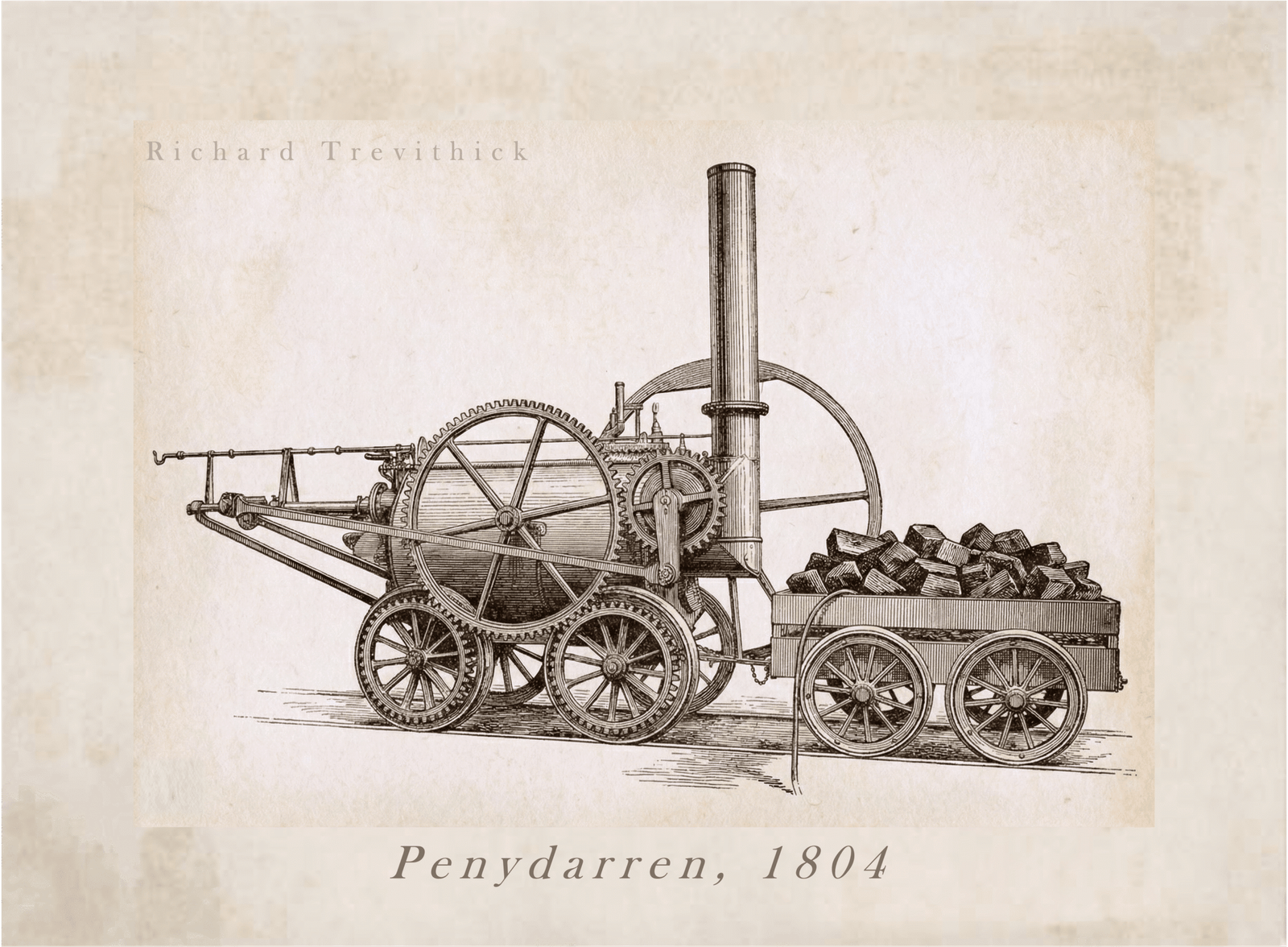
After repairs were made, Trevithick’s machine made further runs to continue testing and improving the technology. A new path seemed to be opening before him, but on the third journey the fragility of the rails forced the machine to a halt, and it had to be towed by horses. That was its final trip. Homfray and the mine owners abandoned the idea of investing in a technology that was creating more problems than solutions: the constant repairs to the rails not only increased costs but also slowed operations. Trevithick watched as the possibility of developing his ideas slipped away.
That machine is considered the first locomotive to run on rails in history: the Penydarren locomotive.
Catch Me Who Can
The experiences with self-propelled road machines and the one he tested on rails at the Penydarren ironworks led Richard Trevithick to redefine his design. He determined that the optimal approach was for the machine to run on rails rather than on the uneven roads of the time, thereby avoiding problems of maneuverability, steering, and mechanical wear.
Four years after his frustrated success at Penydarren, Trevithick embarked on his last great venture as an inventor. With his credibility as an engineer and inventor weakened, finding funding and support for a new project became extremely difficult. However, he managed to secure the necessary capital, and by 1808 he was ready to present his new model. He once again chose London as the setting for its presentation. It was the capital — a modern, cosmopolitan city with a high concentration of wealth. Trevithick would present an alternative for public transport that could transform land transport, and aware that the shadow of his previous failures lingered and that doubts about his work persisted, he decided to change his strategy.
He would present his machine as part of a spectacle, and London was the ideal setting, as it was a city accustomed to hosting large events that drew crowds. He was not seeking technical validation, but rather to create a commercial need through direct public experience. To achieve this, he would appeal to people’s emotions.
He rented a large, open space away from urban traffic in Bloomsbury, near Euston Square, suitable for staging the spectacle without generating complaints about noise, smoke, or possible incidents in public streets. He then began assembling the structure: a circular rail track enclosed by a wooden palisade. The choice of shape was not arbitrary. A circular layout was more practical than a straight track, as it allowed the machine to run continuously without interruption. It also evoked the model of London circuses, reinforcing the spectacular nature of the experience.
The construction, however, posed a significant technical challenge. The available rails were made of cast iron, a brittle material not designed to withstand the weight or constant vibrations of a self-propelled machine. Adapting them to a circular track built on soft ground was a complex task that would determine, though Trevithick did not yet know it, the fate of the spectacle.
The name he chose was Catch Me Who Can. It seems to have originated from an informal suggestion, perhaps from the daughter of one of his collaborators. In any case, it captured the spirit of his invention: a machine that challenged both men and horses to keep pace with it. It was provocative and appealing, and Trevithick used it not only to name the spectacle, but also to name the machine and launch an aggressive advertising campaign based on comparison. He claimed that his Catch Me Who Can could compete with the speed of a horse, reaching up to 32 km/h. Although a galloping horse could exceed that speed over short distances, the fundamental difference lay in endurance: the machine did not tire, it could maintain a constant speed over long periods and cover greater distances. The horse, by contrast, had to reduce its pace to conserve energy and recover from the effort.
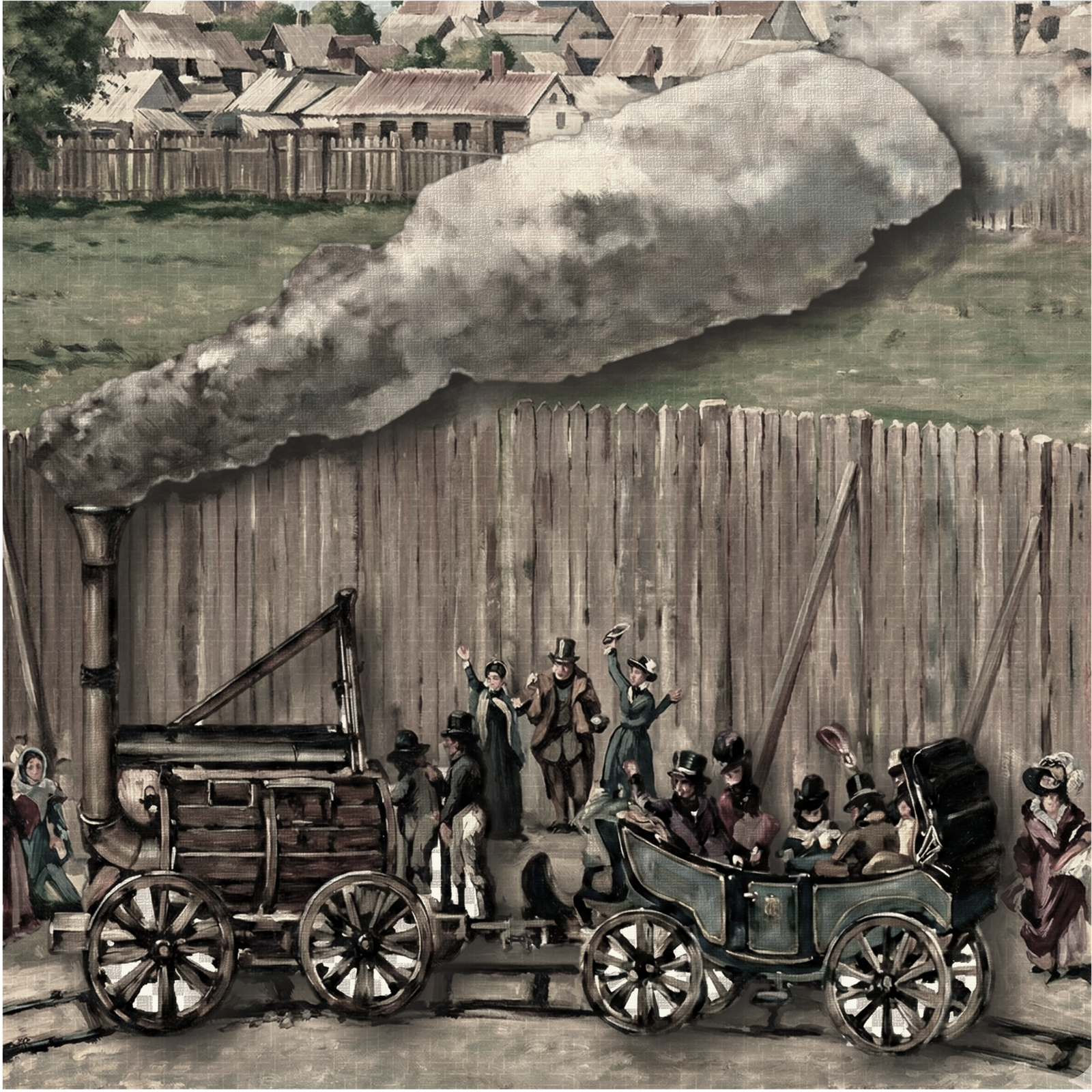
In practice, the speeds reached ranged between 19 and 24 km/h — somewhat below what had been promised, but sufficient to impress those who had never seen anything move like that without animal power.
His aim was not to demonstrate a perfect system, but something more fundamental: that steam power could become the driving force of land transport, and that if Londoners paid to experience his invention firsthand, public demand would generate sufficient interest among investors to finance its large-scale development. The impact needed to be strong enough for others — with greater resources, capital, and infrastructure — to take over and develop the tracks and materials his invention still required in order to succeed.
However, the Achilles’ heel of the spectacle was the fragility of the infrastructure supporting the machine, which led to its premature closure. It represented a financial blow for Trevithick, who not only failed to recover his investment, but was left in debt and in a precarious financial situation. But it was also a severe blow to his morale, and the disappointment ran so deep that it led him to abandon the development of steam-powered vehicles altogether. From that point on, he focused his efforts on less risky mechanical projects: pumps, boilers, mining machinery, and civil engineering works.
Between 1816 and 1827, he moved to the Americas — Peru, Colombia, and Costa Rica — seeking to rebuild his career away from those who knew of his failures and to achieve the financial stability and recognition that had eluded him. That period was marked by constant difficulties, distanced him from his family, and left him nearly ruined.
When he returned to England in 1827, he came back with nothing. By then, the railway was beginning to establish itself as a system of transport— a system he had helped make possible with his Penydarren locomotive. But his record of failures and poor management had closed too many doors for him to secure good contracts, find partners, or obtain institutional support. He did not manage to find stable employment or a permanent residence. In 1833, he fell ill while working for the company John Hall & Sons and died in an inn in Dartford. His situation was so precarious that the factory workers organized a collection to pay for his funeral and prevent him from being buried in a pauper’s grave.
Trevithick’s Legacy
Although Catch Me Who Can failed to meet public expectations or attract investors, it represented a turning point — both technical and cultural — in the history of the railway.
As a spectacle, the Steam Circus helped the idea of the train begin to take hold in the collective imagination. By presenting his machine in a playful setting, in a circus format, Trevithick allowed people not only to enjoy the novelty but to experience first-hand the potential of a technology that had not yet found its name. Without intending to, he anticipated two models that would develop decades later: the mechanical entertainment of fairgrounds, with their circuit rides offering excitement in a controlled environment, and a way of presenting an invention to the world that combines demonstration, emotion, and persuasion — what we would now call marketing.
As a machine, it demonstrated that steam could be applied to land transport, surpassing the speeds then known and leaving behind its principal limitation: dependence on animal power. It was no longer a pipe dream. With that experiment, Trevithick planted the seed for other engineers to develop more efficient and reliable models. Matthew Murray built the Salamanca in 1812; William Hedley and Timothy Hackworth the Puffing Billy and the Wylam Dilly in 1813. Unlike Trevithick, these engineers had the backing of mining companies willing to invest in gradual improvements, which allowed them to experiment, fail, and refine their machines in a controlled environment with sustained support.
It was in 1814 that a young engineer named George Stephenson made his first major contribution to the new world of mechanical transport. Having studied the advances of his predecessors and assessed their strengths and limitations, he designed a locomotive he called the Blücher, incorporating decisive improvements that significantly increased its performance and reliability. Like Trevithick, he envisioned a more ambitious future for these machines — which were beginning to be known as locomotives — and set a larger-scale project in motion. But unlike him, Stephenson understood that success depended not only on developing the machine, but on the environment in which it operated, conceiving the machine and the infrastructure as a single system.
If Trevithick lit the spark, Stephenson fanned the flames: the first showed what was possible; the second made the possible inevitable. With George Stephenson, the history of the train was beginning to pick up speed… But that is coal for another fire.
See you at the next stop: Killingworth
Global ideas, stories connected