
Fourth Stop: Liverpool.
The dawn of the railway age
Home | Edition Nº 1: What is it about trains that fascinates us so much? | Fourth Stop: Liverpool. | The Day the Railway Age Began
Por Mairi Larroque | 2026
On September 15, 1830, a new intercity railway line linking two of England’s most important urban centers — Liverpool and Manchester — was inaugurated. At this stop, we enter that moment when everything converged: euphoria, drama, and the promises of an era only just beginning.
The Grand Inauguration
On September 15, 1830, Liverpool awoke in celebration. That day marked the most anticipated event in recent memory: the inauguration of the Liverpool & Manchester Railway.
The innovative railway line would operate exclusively with steam locomotives, offering entrepreneurs and merchants a modern, fast, efficient, and economical means of transport between the two cities. Yet what stirred the greatest interest — and curiosity — was that it would also provide passenger service, something unprecedented. The idea of traveling in a machine that moved under its own power, at a speed never before seen, was so extraordinary that it pushed the limits of imagination.
For months, both local and national newspapers had followed the line’s progress and, in the weeks leading up to the event, reported every detail of the inauguration, whose principal guest would be the Prime Minister and Duke of Wellington, Arthur Wellesley.
Expectation and curiosity were immense. Lodgings were filled to capacity and, from early morning on the day of the inauguration, crowds filled the city’s streets. Some opponents of the Duke took the opportunity to make their protests heard, but they had little impact and did not disrupt the festive atmosphere.
In the areas around Crown Street and Edge Hill, where the terminus and operations center were located, people jostled for the best vantage points. But how many of those present — beyond a handful of experts — truly understood what a locomotive was, or how a railway worked?
The previous year, the company had staged a competition in Rainhill, near Liverpool, to determine which machine performed best over the fifty-kilometer route between Liverpool and Manchester. The event drew large crowds and also helped familiarize the public with the locomotive, which was variously referred to as a “travelling engine,” a “steam carriage,” or an “iron horse.” Media coverage of both the competition and the development of the line had also helped shape that understanding.
Even so, how it functioned within a large-scale transport system was far from clear. The nature of a machine that moved without animal power was not fully grasped. Some newspapers described it as a fire-breathing dragon; others as an iron creature moving without any visible force. Some saw it as an embodiment of the modern spirit — the triumph of human ingenuity over nature — while more critical voices regarded it as a noisy mechanical monster capable of endangering human life. Despite all the information in circulation, for most people both the locomotive and the railway remained an enigma.
All Aboard
At Crown Street, the Liverpool & Manchester Railway had built a two-story building to manage passenger operations. Although its design was sober and straightforward, it struck most people as remarkable, accustomed as they were to the small offices of horse-drawn coach services.
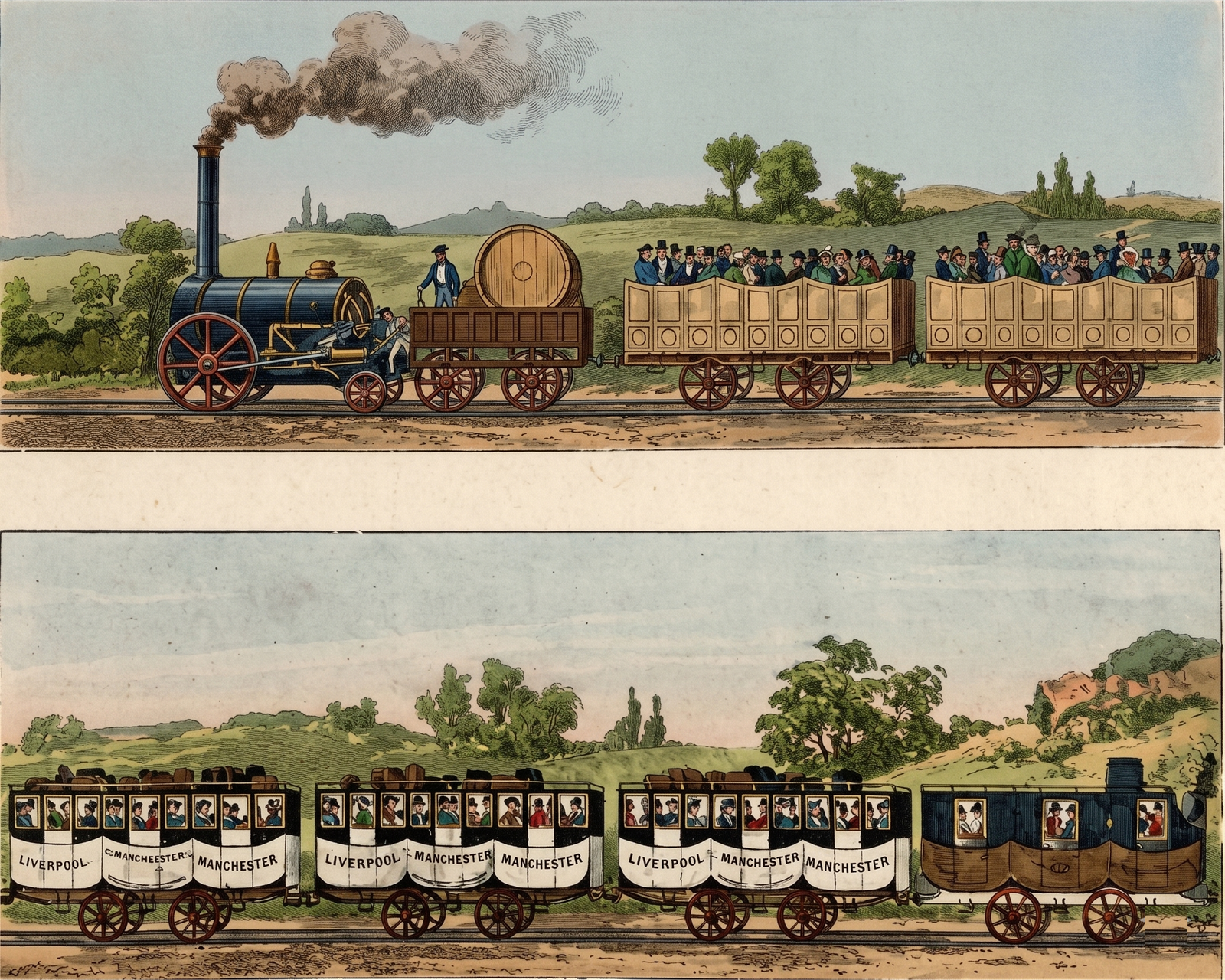
There, at the appointed hour, the special guests gathered to embark. The Duke and his entourage occupied the “ducal carriage,” a carriage designed exclusively for the occasion. It was roofed, taller than the others, and richly ornamented with silks and gilding. The rest of the guests — aristocrats, scientists, artists, members of Parliament, industrialists, ambassadors, journalists, and musicians — took their places in the remaining carriages intended for the line’s regular service. Some were covered, resembling stagecoaches; others were open, more akin to freight carriages.
Once aboard, railway workers began to release the safety couplings that held the carriages in position and, in stages, guided them to the edge of a steep incline at the mouth of a tunnel. They were pushed forward to begin their descent under their own weight to Edge Hill, where the locomotives awaited. The speed of the descent was controlled by the brakeman of each carriage using external levers connected to a braking system.
As the carriages entered the tunnel, darkness gradually enveloped the passengers and the sounds of the outside world faded; it was as if they were crossing a threshold into the unknown. Expectation grew, and in some, so did fear. They suddenly emerged into a deep cutting where the whitewashed walls reflected and intensified the natural light. In the distance stood a monumental Moorish arch, conceived as the great gateway to the city and designed by the architect John Foster Jr. The silence of the tunnel gave way to an eruption of sound: the throaty vibration of the locomotives, mingled with the shouts of railway workers and the clamor of the crowd gathered above. The passengers were enthralled.
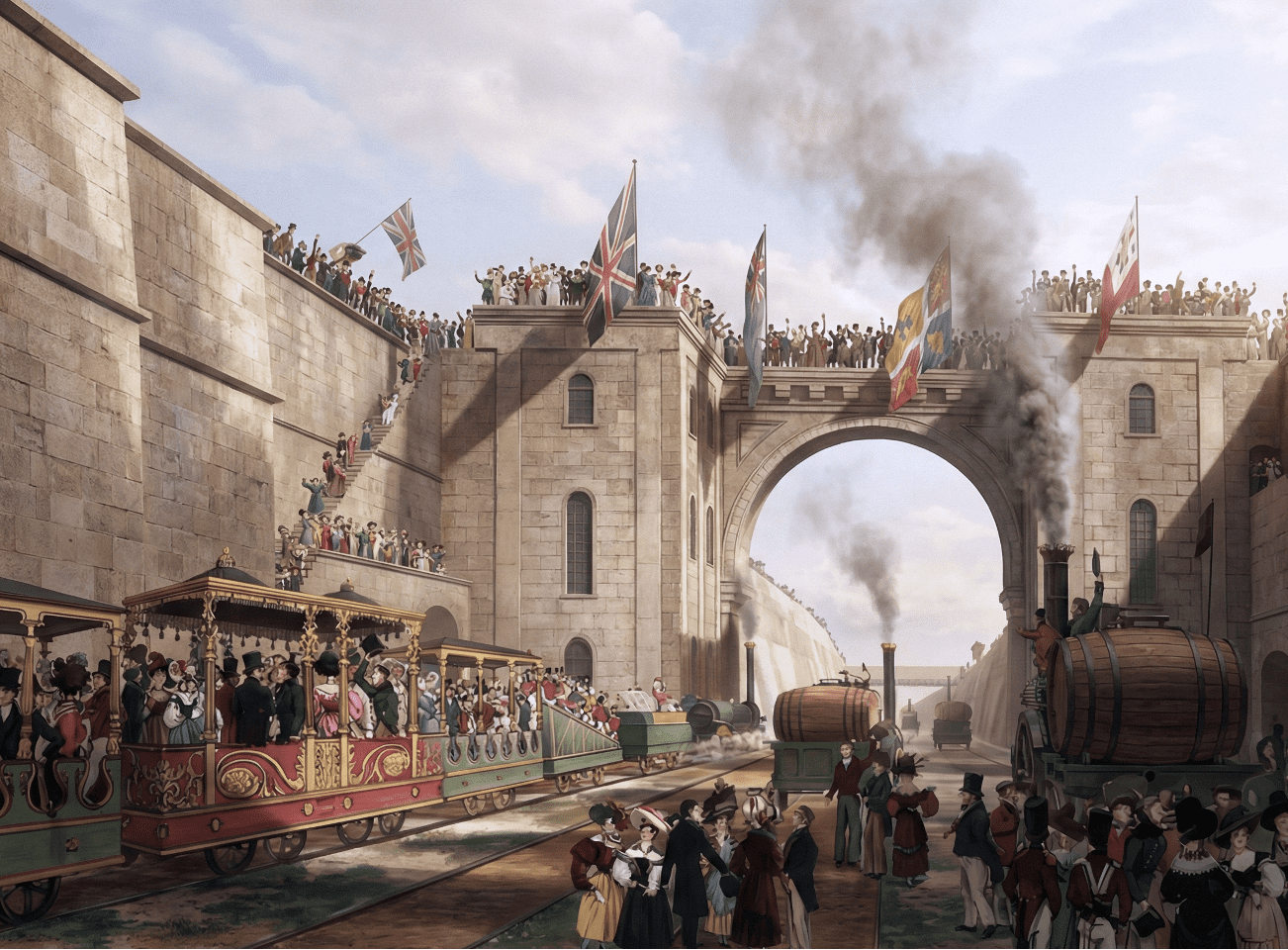
Edge Hill. Inauguration of the Liverpool & Manchester Railway, 1830
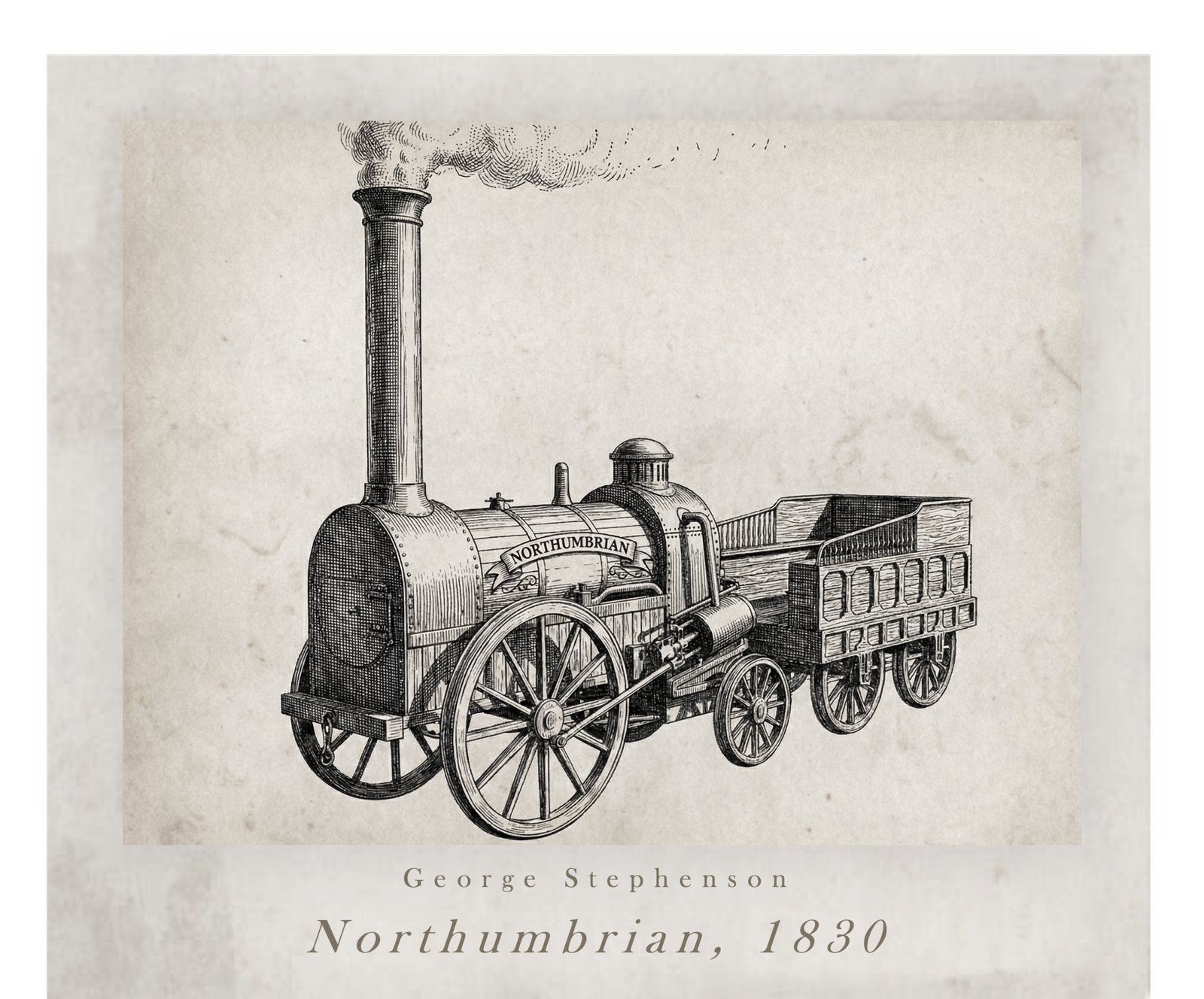
In a coordinated and precise operation, the carriages were coupled to their respective locomotives. On the south track stood the Northumbrian, the most advanced locomotive of all, charged with leading the journey to Manchester. The official party was attached to it, beginning with the musicians’ carriage, followed by the ducal carriage and those of his entourage. On the north track, seven other locomotives were lined up — Rocket, Phoenix, North Star, Dart, Comet, Arrow, and Meteor — to which the remaining carriages were coupled.
The Northumbrian would be driven by its designer, the engineer George Stephenson, the very man who had made possible the construction of that railway line destined to shape the future of land transport. Standing at the controls, his gaze swept over the trains aligned on the adjacent track, the high sandstone walls, the crowd gathered above, and the Moorish arch, within which lay hidden the stationary steam engines responsible for powering the complex system that would haul the carriages back up the incline to Crown Street terminus on their return—a system that, like everything before him, was the product of his ingenuity.
Then, the thunder of a cannon shot echoed against the walls, silencing the crowd and quickening the pulse of the travelers.
It was the signal.
The journey began.
Toward Manchester
The sound of the pistons’ puff, puff blended with the steam escaping from the boilers and the steady clatter of the wheels on the rails. The roar drowned out the cheers, the applause, and the music. Passengers felt the vibration running through the floor beneath their feet and, in a state of exhilaration, they waved farewell to the crowd, which watched them vanish beneath the Moorish arch, wishing to become the next travelers.
The festive atmosphere was not confined to Liverpool. As the trains left the city, they were cheered by thousands of people gathered along the line. The “traveling machines” astonished some and terrified others, but left no one indifferent. Seeing them sweep through the English countryside was not only a spectacle, but also a powerful technological demonstration.Upon reaching Parkside, the Northumbrian stopped to take on supplies at the main service point of the station, as planned. The other locomotives were to take advantage of the pause to pass in front of the Prime Minister, in a display reminiscent of a military parade. They would stop later at their designated refueling points.
Edge Hill. Inauguration of the Liverpool & Manchester Railway, 1830. Original public domain image from Wikimedia Commons. Colorized using artificial intelligence based on the original historical image.
Passengers had been warned that disembarking during stops was strictly forbidden for safety reasons. But the excitement of the moment — and perhaps a false sense of security — led several dignitaries aboard the Northumbrian to disregard the warning. One of them was the Member of Parliament William Huskisson, one of the most passionate advocates of the Liverpool & Manchester line, who had strongly supported the project in Parliament. Huskisson had been on politically strained terms with the Prime Minister for two years, and he took advantage of the good atmosphere to approach him and put aside their personal differences. He walked to the ducal carriage and, as a gesture of courtesy, shook his hand through the window. At that moment, a cry of alarm was heard: “A machine is coming!” It was the Rocket, entering the station for its turn in the procession.
Several people managed to climb onto the carriages or leap to the opposite track. But Huskisson — weakened by a recent surgery and not agile enough — panicked and froze as he saw the locomotive approaching. When he finally reacted, he hesitated between crossing the track or climbing onto the duke’s carriage. He chose the latter. He grabbed a side door that was not secured by its latch, and his own weight forced it open to a ninety-degree angle, projecting it directly into the path of the Rocket.
The driver of the Rocket, Joseph Locke, desperately attempted to brake the engine, but he could not avoid striking the solid wooden door, which was hurled into the air along with Huskisson. The MP fell with one of his legs across the rails. His screams and the sound of the wheels crushing his leg left everyone in shock.
At Full Speed
George Stephenson reacted immediately. He ordered the Northumbrian to be uncoupled from its carriages, leaving only the band carriage attached in order to improvise an emergency transport. The railway workers lifted Huskisson aboard as best they could, together with the physicians traveling with the party, who were already attending to him, and set off for Eccles, the nearest town. Stephenson drove the engine at an extraordinary speed for the time, between 36 and 40 miles per hour.
In Eccles, he left the injured man and the doctors at the town vicarage and “flew” to Manchester to find the surgeons the physicians had recommended. He soon returned with assistance, and seeing that the situation was under control, set off once more to rejoin the procession. He found them near Chat Moss.
Meanwhile, back at Parkside, Arthur Wellesley, shaken by the tragedy, asked to return to Liverpool immediately. However, his advisers and the railway directors urged him to continue the journey, arguing that a large crowd awaited in Manchester and that, if the procession failed to arrive and the official ceremonies were canceled, unrest could break out that would be difficult to control, damaging both the Duke’s reputation and that of the railway. Wellington, not entirely convinced, agreed.
But there was a logistical problem, both for continuing to Manchester and for returning to Liverpool: the carriages of the Northumbrian had to be coupled to the other locomotives. In that section of the line there were no points to switch between tracks, forcing the engineers to devise an alternative method of coupling. They used a long chain to attach the stranded carriages on the south line to one of the locomotives on the north line. It was a complex and risky maneuver that required precision and skill. After more than an hour of work, the procession finally set off slowly toward Manchester.
When Stephenson rejoined the party, he informed the Duke about the condition of the injured man, stating that he had successfully undergone an amputation in order to save his life. However, at the time Stephenson had left Eccles for Chat Moss, the surgeons were still working to stabilize Huskisson and had not dared to perform such a procedure, given the delicacy of his condition. It is unclear on what basis Stephenson gave this information. It is possible that the physicians had indicated that this would be the intended course of action and he assumed it had already taken place, or that he concluded on his own that, given the nature of the injury, amputation was the likely outcome.
In any case, the news helped to restore a certain sense of optimism to the atmosphere and dispel any intention Arthur Wellesley may have had of returning to Liverpool. The ducal carriage and the carriages of his entourage were then reattached to the Northumbrian, and the journey resumed toward Manchester, gradually regaining the speed at which the procession had been traveling before the accident.
Finally, Manchester
As they approached Manchester groups stationed along the railway line greeted them holding banners and placards—but not of welcome. They were filled with political slogans directed against the Duke and his entourage. Upon recognizing the ducal carriage, they began to jeer, shouting insults and even throwing objects.
The hostility intensified as they neared Liverpool Road terminus. There the agitated crowd, despite the deployment of troops and cavalry, flooded onto the tracks to block the passage of the locomotives, which were forced to advance at a very slow pace through the mob.
The protesters were representatives of Manchester’s working class, discontent after years of repression and political exclusion: they had no representation in Parliament and considered themselves harmed by the reforms promoted by Arthur Wellesley and his government. Their protest was not against the railway itself, but against the British elite traveling in its carriages. Many of those demonstrators wore tricolor cockades in their hats, a direct challenge to Wellington and what he represented, signaling that the spirit of insurrection, shaped by the ideals of the French revolutions (the most recent of which had taken place that very year and had led to the overthrow of King Charles X), was spreading through British streets.
Security detachments partially contained the situation, and the Duke, fearing for his safety, refused to disembark from his carriage, ordering instead an immediate return to Liverpool. But preparing the return took time, both for the mechanical adjustments required and for the logistical coordination of departure. Once the Northumbrian was ready, Stephenson set off back toward Liverpool with the Duke and his entourage.
The remaining locomotives and passengers were left stranded on Liverpool Road while engineers and mechanics urgently reorganized the engines for the return journey. Only three locomotives were made operational. They were then coupled together to generate sufficient power to pull more than twenty carriages in a single convoy.
The return journey became a true ordeal. Heavy rain set in, reducing visibility and affecting traction on the rails. The journey grew long, difficult, and exhausting. Rain soaked passengers in open carriages, while the locomotives were forced to stop repeatedly, unable to overcome inclines under such weight. Night fell, and without lighting to guide the way, the remainder of the journey was marked by uncertainty and fear.
Finally, after more than six hours, the travelers arrived at Crown Street—hungry, exhausted, and many completely drenched. They did not yet know that, during their return, William Huskisson had died in Eccles after hours of agony, during which doctors attempted to relieve his pain with medication, as surgical intervention had proved impossible.
What had begun as an extraordinary day, marked by euphoria and triumph, ended in tragedy.
The following day, news of Huskisson’s death spread rapidly. And although it caused shock and opened a debate about the risks and viability of the new means of transport, it also helped intensify interest in the railway. The speed achieved by the Northumbrian in its desperate run from Parkside to Eccles—unthinkable for the time—in an attempt to save the life of the MP, became an episode discussed with admiration and curiosity not only in Britain, but beyond its borders.
A New Era Begins
The inauguration of September 15, 1830 was a decisive demonstration that, in just a few hours, condensed the promises and risks of modernity, and revealed the potential of a transport system that, from that day forward, would transform the world.
Despite the controversies surrounding its inauguration, the Liverpool & Manchester Railway began formal operations a few days later. The public flocked to it in large numbers, eager to experience rail travel for themselves. Hundreds of passengers filled the carriages in the first week, and soon the numbers multiplied into the thousands, exceeding even the expectations of the investors, who had primarily envisioned freight rather than passenger transport as the main source of revenue.

Entrance into Manchester across Water Street, engraving by Henry Pyall based on a work by Thomas Talbot Bury, 1833. Public domain via Wikimedia Commons.
For the first time, citizens experienced the comfort of covering the journey between the two cities in a fraction of the usual time. The trip, which had previously taken more than six hours by stagecoach or up to a full day by canal, was reduced to just over two hours. From the outset, a regular service was established — at least five trains per day in each direction — with scheduled departures and arrivals, a true revolution. Demand grew so rapidly that the company was forced to increase frequency almost immediately. Soon, desire and curiosity turned into necessity.
Another innovation was the stratification of service through the introduction of class-based ticketing. First-class passengers paid a higher fare in exchange for traveling in enclosed carriages — similar to luxury stagecoaches — with glass windows, cushioned seats, and full protection from the weather. Second-class passengers paid less, but traveled in open carriages exposed to wind, rain, smoke, and sparks emitted by the locomotive. Over time, and in response to repeated complaints about dirt and burned clothing, these carriages were roofed to provide basic shelter. This improvement relegated the fully open carriages to a new category, third class, whose passengers traveled in precarious conditions, often standing and fully exposed to the elements.
The Liverpool & Manchester line operated as a true laboratory in which the standards of the industry were defined. In addition to running on double track — essential for ensuring smooth traffic flow — the company developed the first operational protocols through a system of manual signaling. It expanded and professionalized the railway police service, already present on the Stockton and Darlington Railway, organizing it as a specialized body — the Police Establishment — with agents stationed at regular intervals, responsible both for safety and for key technical functions such as operating points and transmitting signals using flags and lamps.
Its operation and reliability led the Crown to award it the transport of the Royal Mail. By entrusting postal bags to the railway, the state institutionally legitimized the reliability and superiority of the new system.
George Stephenson: The Engineer Behind the System
For engineer George Stephenson, the success of the Liverpool & Manchester Railway marked a turning point in his career. His talent, strategic vision, and pioneering work in the railway industry were fundamental in the development of one of the greatest technological and engineering achievements of the century, solving technical problems no one had previously faced, overcoming geography in places that had seemed insurmountable, and defeating the strong opposition of landowners, some Members of Parliament, and businessmen who resisted the new technology.
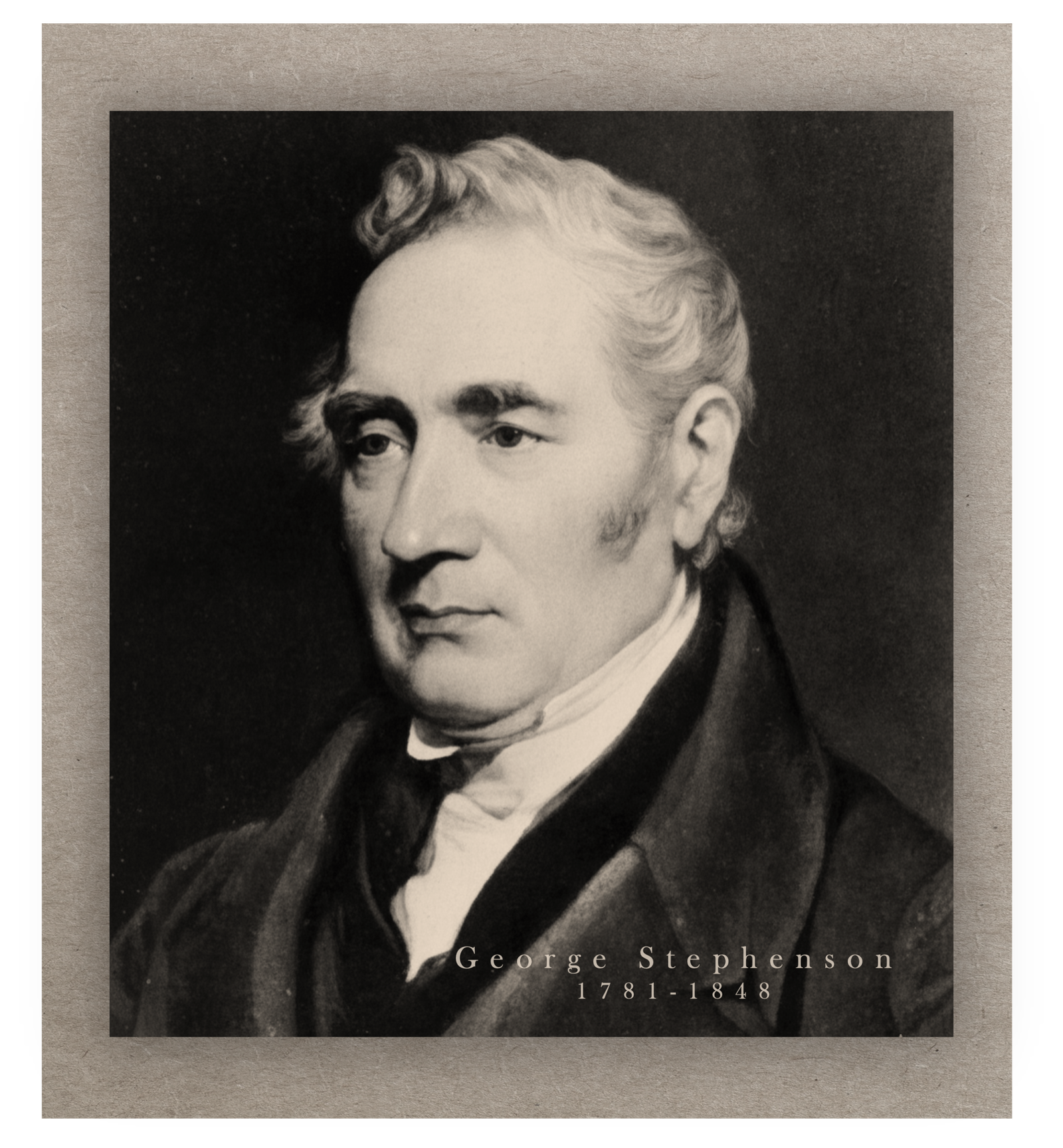
Although his earlier work — the railway system of the Killingworth collieries and the Stockton & Darlington Railway — had already demonstrated his abilities as an engineer and project leader, it was the construction of the Liverpool & Manchester line that definitively established his national and international reputation. Stephenson, a man forged in the harsh world of mining, without the social polish that distinguished the gentlemen of his time, but with a brilliant mind and an extraordinary ability to solve complex problems, became one of the most respected and admired figures of the Industrial Revolution. In time, he would be known as “the father of the railway.”
The Transformation
The overwhelming success of the Liverpool & Manchester Railway functioned as a true “Big Bang” of land transport — the moment from which railway expansion began to accelerate rapidly and continuously. Within a few years, railway companies multiplied across Great Britain and beyond its borders, driving the development of a vast network that interconnected cities and transformed the economy, communications, and the very perception of space and time.
As the railway network expanded and connected places, it also transformed its surroundings and began to integrate into the landscape. It crossed mountains, rivers, and vast plains; reached territories that had previously been inaccessible; stimulated the growth of urban centers and gave rise to new towns and cities. The railway became the skeleton of modernity—a dynamic structure that organized territory and defined the nerve centers of a new order.
One of the key spaces within the railway ecosystem that began to gain prominence was the railway station. At major points in the network, stations ceased to be merely utilitarian buildings and became urban landmarks and multifunctional spaces. It was no longer enough to have a ticket office, a warehouse, and a functional platform. The volume of traffic demanded increasingly large, complex, and efficient buildings that also possessed architectural identity.
The first railway stations in history — Crown Street in Liverpool and Liverpool Road in Manchester — are examples of this transformation. Both functioned as peripheral terminals, but the rapid growth of commercial activity and the increase in passenger volume not only overwhelmed them, but also made clear the need for stations with greater operational capacity, organically integrated into the urban fabric.
Crown Street ceased operations in 1836, and its modest two-story building, which had witnessed the departure of the first passengers in history to travel in a steam locomotive, was demolished shortly thereafter. The site was repurposed to expand coal storage facilities and convert it into a freight yard. Passenger operations were transferred to the new Liverpool Lime Street station, located in the heart of the city, with a neoclassical façade and an interior illuminated by a glazed wooden train shed supported by iron columns, giving it a sense of openness and modernity.
The case of Liverpool Road was similar, although it remained in operation as a passenger terminal for longer. In 1844, passenger services were transferred to the new Victoria Station in central Manchester, near the cathedral. It soon became one of the largest railway stations in Great Britain. The Liverpool Road building was not demolished; instead, it continued operating as a major freight yard. Today it is recognized as the oldest surviving railway terminus in the world and forms part of the Science and Industry Museum of the city.
The design of railway stations began to play an increasingly central role. By the end of the nineteenth century, in major urban centers — or those aspiring to become such — the architectural dimension of stations had become as important as the technological innovation and engineering behind the railways themselves.
Cities such as London, Paris, Berlin, and Vienna took pride in their great terminals, conceived not only as points of departure and arrival, but as true urban landmarks. They were spaces that projected power and modernity, multifunctional buildings — with waiting rooms, restaurants, hotels, and shops — that embodied the spirit of their time.
At the beginning of the twentieth century, when the railway had already woven an extensive network across the industrialized world and electricity was beginning to replace steam in urban sections and major terminals in response to the limitations of steam power, one city stood at the forefront of this transformation. There, an innovative terminal would be built that was more than a station—it would become the epicenter of unprecedented urban development.
That city was New York.
Its terminal would redefine the role of the railway station in the modern metropolis.
But that is a story for the next stop.
Global ideas, stories connected