
Third Stop: Killingworth.
VORWÄRST!
Por Mairi Larroque | 2025
After seeing Richard Trevithick’s first attempts to make steam locomotion a success at the previous stop, we arrive at a turning point in this third stop: the moment when the machine ceases to be a curiosity and becomes a system — the railroad. Welcome to Killingworth, the industrial laboratory where the intelligence of a self-taught engineer and a specific historical necessity converged to take the decisive step. Vorwärts! The conquest of land transport.
June 1814. Prussian Field Marshal Gebhard Leberecht von Blücher (1742–1819) arrived in London on an official visit following the triumphs that had forced Napoleon’s abdication and his exile to the island of Elba. The streets were packed to welcome him, and amid cheers and shouts of Vorwärts! (Forward!) — the battle cry that earned him the nickname Marschall Vorwärts — frenzied admirers surged toward his carriage. They wanted to touch him; they wanted him to return their gaze; they needed to take something from the hero who had liberated Europe.
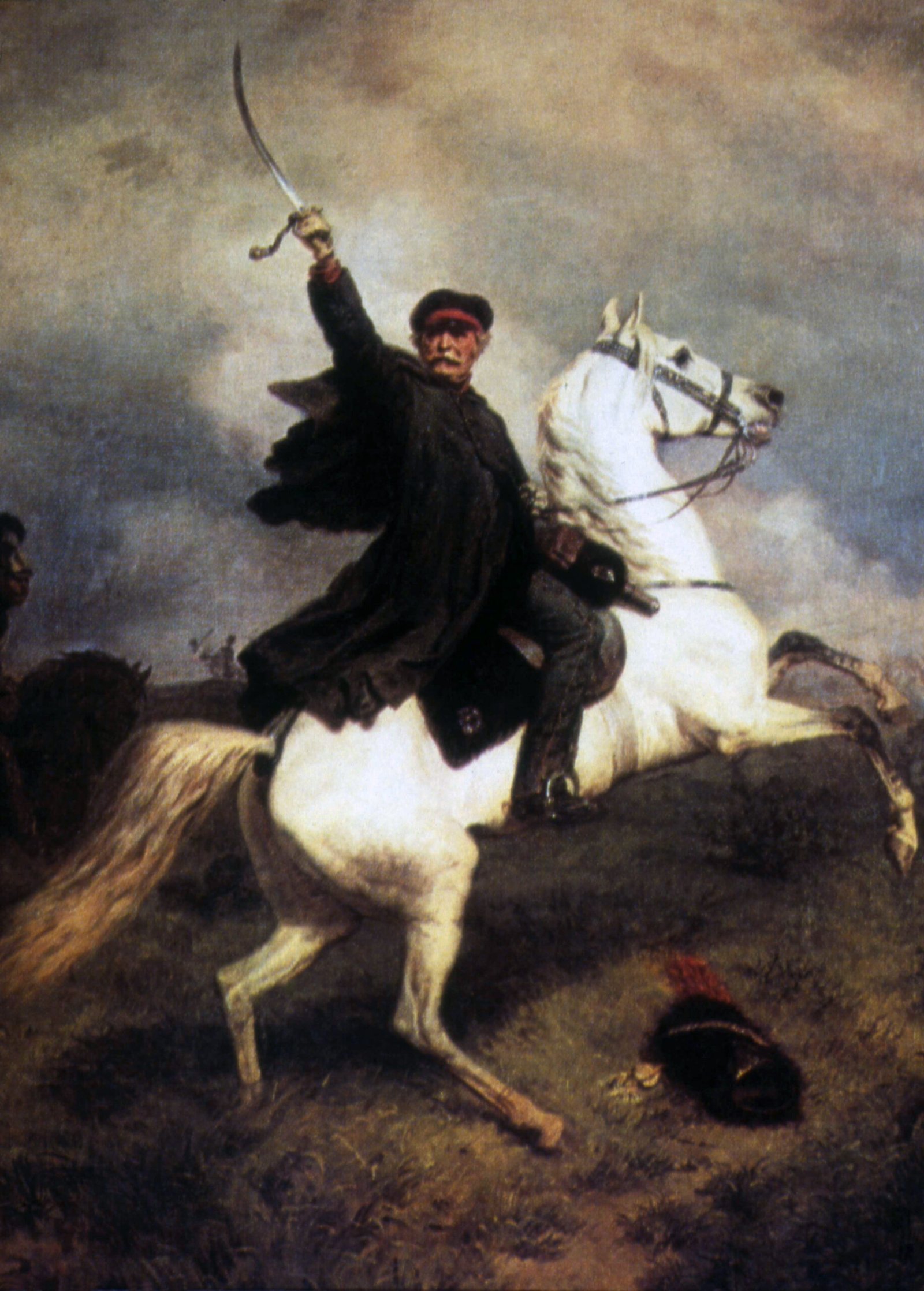
Marschall Vorwärts, by Emil Hünten (1863). Public Domain via Wikimedia Commons.
While London was swept up in a frenzy over the Prussian marshal, hundreds of miles to the north, in the maintenance workshops of the Killingworth mines, engineer George Stephenson (1781–1848) was forging, amid the fire of the forge and the clanging of hammers, a self-propelled steam machine with which he intended to modernize the transport system on which the mine depended to bring its coal to market. The engineer and his men also celebrated the triumphs of the septuagenarian marshal and breathed in the air of victory drifting from the capital; what better way to honor the hero of the moment than by naming the powerful machine — then in its final stage — after him: the Blücher.
Stephenson tested it on the Killingworth rails in July. The Blücher successfully hauled several wagons loaded with tons of coal, demonstrating its power and effectiveness, and opened the way for its creator to take the first steps in a direction from which there would be no turning back. Vorwärts! The age of the railroad had begun.
Curious Hands, a Restless Mind
In the small village of Wylam, in Northumberland, in the north of England, a boy of barely seven or eight worked tending a neighbor’s cows. In exchange for a modest wage, he had to keep them from blocking the wagonways along which coal from the mines was transported to the port.
His name was George, and he was the second child of Robert and Mabel Stephenson. Curious and observant, he was fascinated by nature, but also by understanding how things worked: a rabbit trap, a water mill, or the large steam engines that loomed at the mouths of the mine. Among his favorite pastimes was modeling miniature replicas in clay—of water mills and, above all, of steam engines. He used hemlock stems to simulate pipes and pistons, trying, with his still-clumsy hands, to unravel the workings of those iron monsters.
Young George did not go to school. It was a luxury his parents could not afford and did not consider essential for earning a living. His father himself could neither read nor write, and he did not need to in order to work honestly as a fireman on a steam engine. Robert knew that the boy, as was customary in the area, would follow in his footsteps; to be a miner required only strength and skill. That was not something learned at school.
Around the age of ten, the boy began working at the mine as a picker, a tedious and grueling task that consisted of separating stones and waste from usable coal, though at least it was done outdoors. But George — strong, intelligent, and skillful — wanted to learn other trades within the mine, and one day to work with the machines he so loved to model from river clay. He quickly distinguished himself among the other children for both his intelligence and his stamina, as well as his ability to adapt to the suffocating and toxic environment of the mine. He took on new tasks, venturing into the dark galleries, seizing every opportunity to demonstrate his manual skill and his instinct for solving problems, especially mechanical ones. Thus, amid darkness, soot, and steam, he survived the constant dangers of the mining environment, gaining experience and strengthening not only his body but also his mind.
As he entered adolescence, George began taking on more technical work, eventually working alongside his father as an assistant fireman, helping to stoke the steam engine’s boiler and attending to other tasks related to the operation of the equipment. This practical exposure allowed him to learn everything he could about the behavior and maintenance of the machines, and his talent and initiative led him, at only seventeen, to earn on his own merits the position of engineman at the Water Row Pit mine, in the nearby village of Newburn, downstream from Wylam. Although he was very young, he already had a decade of work behind him and stood out not only for his physical endurance but for his intelligence and ability to solve problems in a demanding mechanical environment.
However, George was not satisfied with practical experience alone. He wanted to understand deeply the technology in his hands, and his illiteracy was beginning to become a barrier limiting his growth. At eighteen, he decided to invest part of his modest wage in night classes to learn to read, write, and acquire basic arithmetic. Once he mastered the fundamentals, he continued educating himself, discovering a world of advances and discoveries that stimulated his mind and fueled his desire to learn. He read technical manuals, practical treatises on mechanics, and anything he could get his hands on, striving to apply that theoretical knowledge to his daily work. George wanted more. The effort soon bore fruit. That unusual combination of manual skill and self-taught knowledge opened new doors in the mining industry. Within a few years, he had gone from being an illiterate young engineman to one of the most capable and respected operators in the field.
Killingworth
By 1812, George Stephenson had steady employment and had come much further than any of the boys with whom he had once worked in the Wylam mines. He held the position of brakeman, responsible for operating one of the winding engines at one of the shafts in the Killingworth Colliery complex. His job consisted of controlling the hoisting mechanism to manage the vertical traffic of the shaft, raising the tons of coal that were extracted and transporting the teams of miners down into the depths and back up again to the surface. In addition, he was responsible for the maintenance of the machine itself. It was a role essential to the operation of the mine, requiring, on the one hand, great skill to control with precision the rhythm of ascent and descent, “braking” the machine at exactly the right moment, and on the other, mechanical knowledge and technical ability.
In his personal life, Stephenson had been widowed in 1806 — his wife and second daughter died during childbirth —and he lived in a modest cottage within Killingworth with his only son, Robert, born in 1803. For many years, after his long working days, he devoted himself not only to self-education, but also to repairing shoes and clocks to supplement his income, taking on any work that would allow him first to support his family, and later his son. Stephenson knew his limitations very well: his rough manners, his lack of social refinement, and his strong Geordie accent kept him at a distance from the more polished circles of British society; he would never speak the refined English of the capital, nor would it be easy for him to fit into the drawing rooms where the advances of the age and matters of public interest were discussed. But he made sure to build a different future for his son, sparing him from the hardships and privations that he himself had endured. For this reason, he made every effort to pay for his education in the best schools in Newcastle and to give him access to a world broader than that of the mines.
Stephenson was not a conformist, and just as he was aware of his limitations, he was equally aware of his strengths. He trusted that his sharp mind and mechanical knowledge could open a path for him. He only needed to remain attentive to seize the opportunities that might arise—and one did appear in 1812 while he was on his way to work.
One of the pumping engines in the complex, located at the so-called High Pit, had been failing for months, and flooding in the galleries had become uncontrollable. For almost a year, engineers and technicians had worked without success to repair it. Stephenson passed by the machine every day and, over time, became familiar with the situation, discreetly observing the repair work while continuing with his own duties. His inquisitive mind became increasingly interested in the machine; whenever possible, he would stop to examine its mechanism and listen to the sound of its gears. Gradually, he came to understand the nature of the problem and began to see possible solutions, but he knew he was only an operator and that the engineers were still attempting to resolve it.
When the owners’ concern turned to desperation at the engineers’ inability to solve the problem, Stephenson saw the opportunity to offer his help. He approached the foreman, Kit Heppel, with whom he had a good relationship, and told him he could repair the machine within a week. Heppel knew Stephenson’s ingenuity and mechanical skill and passed the offer on without hesitation to the desperate owners. Given the critical situation—and with nothing to lose—the owners granted him permission. Stephenson set to work, and in less than four days, the machine was running again. His success was rewarded with one of the most important positions in the mine: enginewright.
In his new position, Stephenson was not only responsible for the maintenance of the steam engines of the complex, but also for the supervision of the mine’s entire infrastructure. From operator to chief engineer almost overnight, his salary increased substantially, and he was assigned a horse for moving around the complex—a privilege and a clear sign of status. Stephenson quickly identified the problems affecting the operation of the mine, transport among them. To optimize coal distribution, he redesigned the branch lines through which the wagons circulated and introduced inclined planes at strategic points that made use of gravity. However, he soon understood that no matter how many improvements he introduced, as long as the system depended on the limited strength of horses, the scope for progress remained very restricted.
In search of alternatives, Stephenson began to take an interest in steam locomotion, an experimental technology that, after years of stagnation, was beginning to gain new momentum. Richard Trevithick had been the first to build self-propelled steam engines on rails: the Penydarren (1804) for freight transport and the Catch Me Who Can (1808) for passengers. However, his machines broke cast-iron rails, and, frustrated by technical and financial failures and a lack of support, Trevithick abandoned the development of the technology he himself had invented.
Four years passed before other engineers took up the challenge, and two models emerged with different solutions to the problem of the rails: the Salamanca (1812), by Matthew Murray and John Blenkinsop, and the Puffing Billy (1813), by William Hedley.
In 1813, Stephenson traveled to Leeds to see the Salamanca operating in the Middleton mines. He studied its rack-and-pinion system, designed to ensure traction without breaking the track. Although effective, its mechanism was noisy, its speed limited, and its production cost very high. He then visited the Wylam mine to study the Puffing Billy, which used smooth wheels but redistributed weight more efficiently by increasing the number of axles and wheels; nevertheless, its enormous mass still severely damaged the infrastructure. Analyzing both models, Stephenson leaned toward Hedley’s approach, understanding that by adapting the design to the conditions of Killingworth — the track, the terrain, and the demands of the mine — friction–based traction could work reliably. He had the vision and knowledge to design an improved version; now he only needed to convince the owners to finance his project.
He presented his idea to the principal owner of the Killingworth mines, Lord Ravensworth. Though Stephenson was not a polished speaker, the soundness of his arguments and the firmness of his conviction were enough to persuade him. Ravensworth was enthusiastic about the prospect of building a machine capable of replacing animal power and increasing the mine’s productivity, as well as about the opportunity to place his business at the forefront of the technological advances of the time. Without hesitation, he approved the project, and Stephenson, without delay, set to work.
In the workshops at West Moor, used for repair work, he began — together with several assistants — to give shape to his machine. Every part was forged, tested, and fitted by hand in a fully artisanal process. Among the innovations was the addition of a small flange on the wheels to act as a guide, as well as a slight inward inclination of the contact surface designed to improve grip and prevent derailments on curves. Finally, in July 1814, the machine was ready, and the 25th was set for the first trial.
When the day came, the mine’s workers and owners gathered to witness the debut of Stephenson’s machine. There was an atmosphere of curiosity, apprehension, and skepticism. That iron monster seemed excessively heavy, and many doubted that the fragile rails would withstand its passage. Among the horse drivers, a sense of anxiety arose: if the machine worked, would they lose their jobs? Everyone sensed that, if it passed the test, the logistics of the mine would change completely, although no one yet understood how.
The machine — loud and rough — was coupled to eight wagons loaded with thirty tons of coal. At the signal, jolting and hissing, it moved forward slowly at about 4 mph (6.4 km/h), the structure creaking under its weight. To the surprise of the skeptics, the rails held, and the machine completed the journey without incident. It was not fast, but in a single run it was capable of transporting an enormous quantity of coal.
Stephenson named his machine Blücher, caught up in the “Blücher mania” that followed the Prussian marshal’s visit to England the previous month. For Stephenson, naming his machine after an illustrious figure was more than a tribute. It was not only an association with a hero universally admired — the machine embodied the same brute force and relentless determination as the old warrior. It is also likely that Stephenson saw himself reflected in the marshal: both were men of action, shaped by hardship and effort, who had prevailed in their respective fields through iron will, strategic vision, and a determination that did not yield to difficulty.
Lord Ravensworth and his partners were satisfied with the Blücher’s performance and supported its integration into the work of the mine. However, Stephenson never regarded it as a finished machine. It was, above all, a successful experiment, a real-world test that allowed him to identify flaws, implement solutions, and confirm that steam locomotion on rails was the future. The Blücher was the starting point from which Stephenson could move forward and trace the path that would ultimately transform land transport.
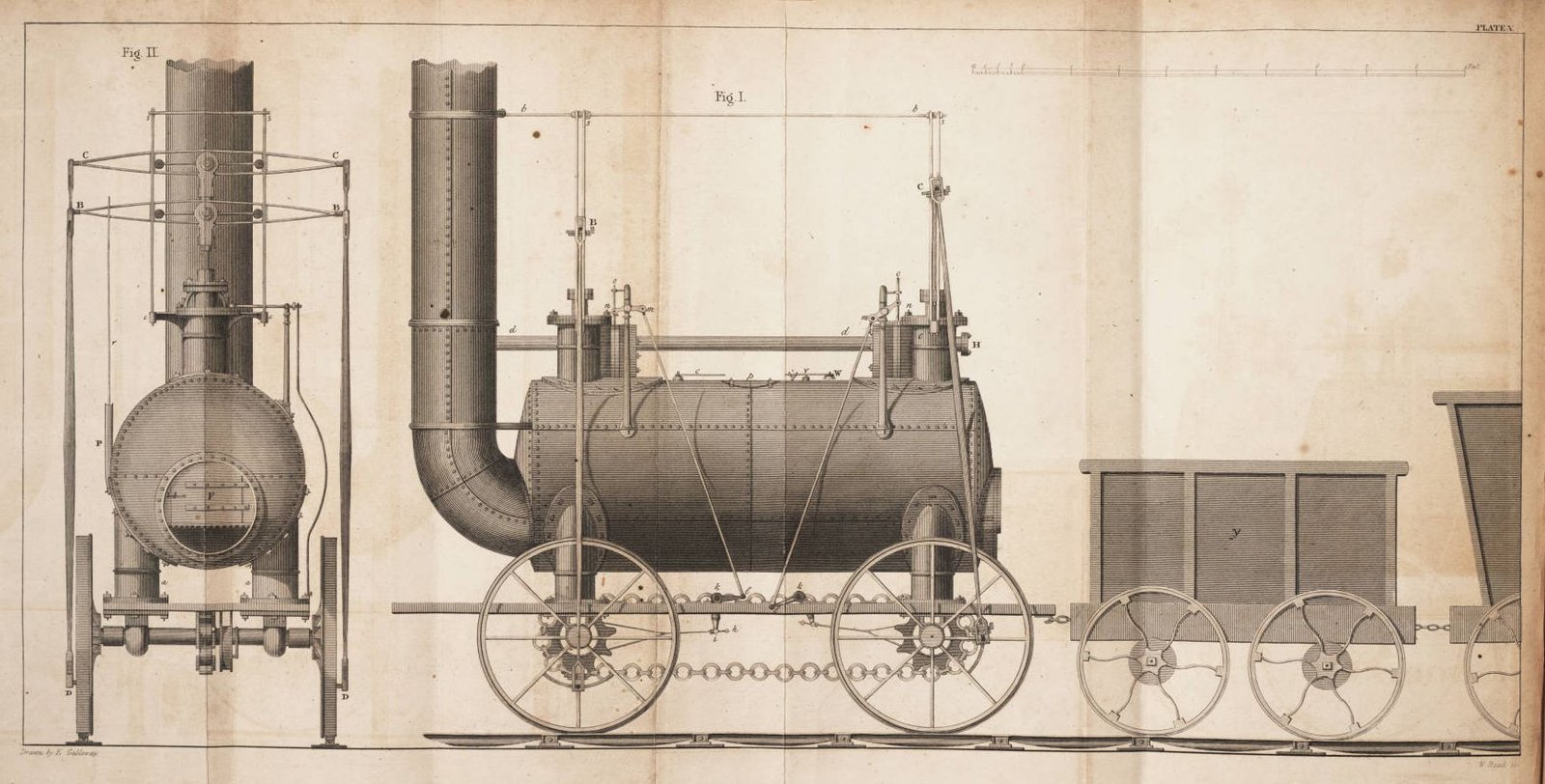
Killingworth locomotive engraving (c. 1815-1825) / Public Domain.
But Stephenson’s key insight was understanding that the new technology was not about the machine alone, but about an integrated system that included both the machine and the infrastructure and logistics. Guided by this vision, he began to modify and optimize the layout of the Killingworth tracks. He built new branch lines and introduced wrought-iron rails — a new technology, stronger and more durable than cast iron — combined with wooden sleepers; he also continued improving the locomotives that replaced the Blücher in order to achieve greater adhesion, stability, and increased speed and power. Stephenson created a complex and functional transport network, an interconnected system that transformed the mine’s productivity. Killingworth became his testing ground, the place where he began to lay the foundations of the first railway system.
Stockton & Darlington
In 1821, word reached Stephenson that Edward Pease, a prominent businessman from Darlington, had just obtained parliamentary permission to build a railroad to transport coal from the Witton mines to the port of Stockton. The project was ambitious but conservative: it was conceived as a traditional wagonway, operated exclusively by horses. Stephenson immediately saw in it the opportunity to apply on a large scale the railroad system he had perfected at Killingworth.
He wasted no time and decided to present himself in person at Pease’s home in Darlington, without an appointment. He knew that his rough appearance and strong northern accent could make his proposal difficult to follow, so he brought Nicholas Wood, general supervisor at Killingworth, along for support. Wood’s presence not only offered practical backup — it lent credibility to Stephenson and helped bridge the communication barrier. The businessman was surprised to see those dust-covered men who had come from so far away, but he received them in his study with a degree of mistrust, prepared to send them on their way as quickly as possible.
Stephenson got straight to the point and set out with conviction his vision for the use of steam locomotion in the project. He declared that one of his locomotives was worth fifty horses and explained that a railroad would not only optimize the coal trade but transform the very concept of transport, opening the door to the mass movement of freight and, eventually, of passengers. He was so persuasive that Pease was impressed not only by his honesty but by the depth of his knowledge. He accepted the proposal and, to ensure the project’s viability, commissioned Stephenson to carry out a new topographical survey of the line. Stephenson’s work, impeccable, dispelled any remaining doubts, and Pease appointed him Chief Engineer of the Stockton & Darlington Railway (S&DR). He also took charge of securing the parliamentary approval needed to amend the original project and allow the use of locomotives.
The survey, carried out with the collaboration of his son Robert — who was taking his first steps as an engineer — made clear that in order to carry out a modern, ambitious project, they needed suitable locomotives and workshops capable of building them to the required precision. Faced with that challenge, father and son conceived the idea of creating a company dedicated exclusively to locomotive manufacturing. They partnered with Edward Pease and other entrepreneurs and founded the Robert Stephenson & Company, the first locomotive factory in history.
Their first machine was the Locomotion No. 1, the same locomotive that inaugurated the line on September 27, 1825. That day, George Stephenson took command of the locomotive like a true captain. With pride, he drove it on a historic journey: for the first time, a locomotive hauled on a public line a convoy carrying freight and — most revolutionary of all — passengers.
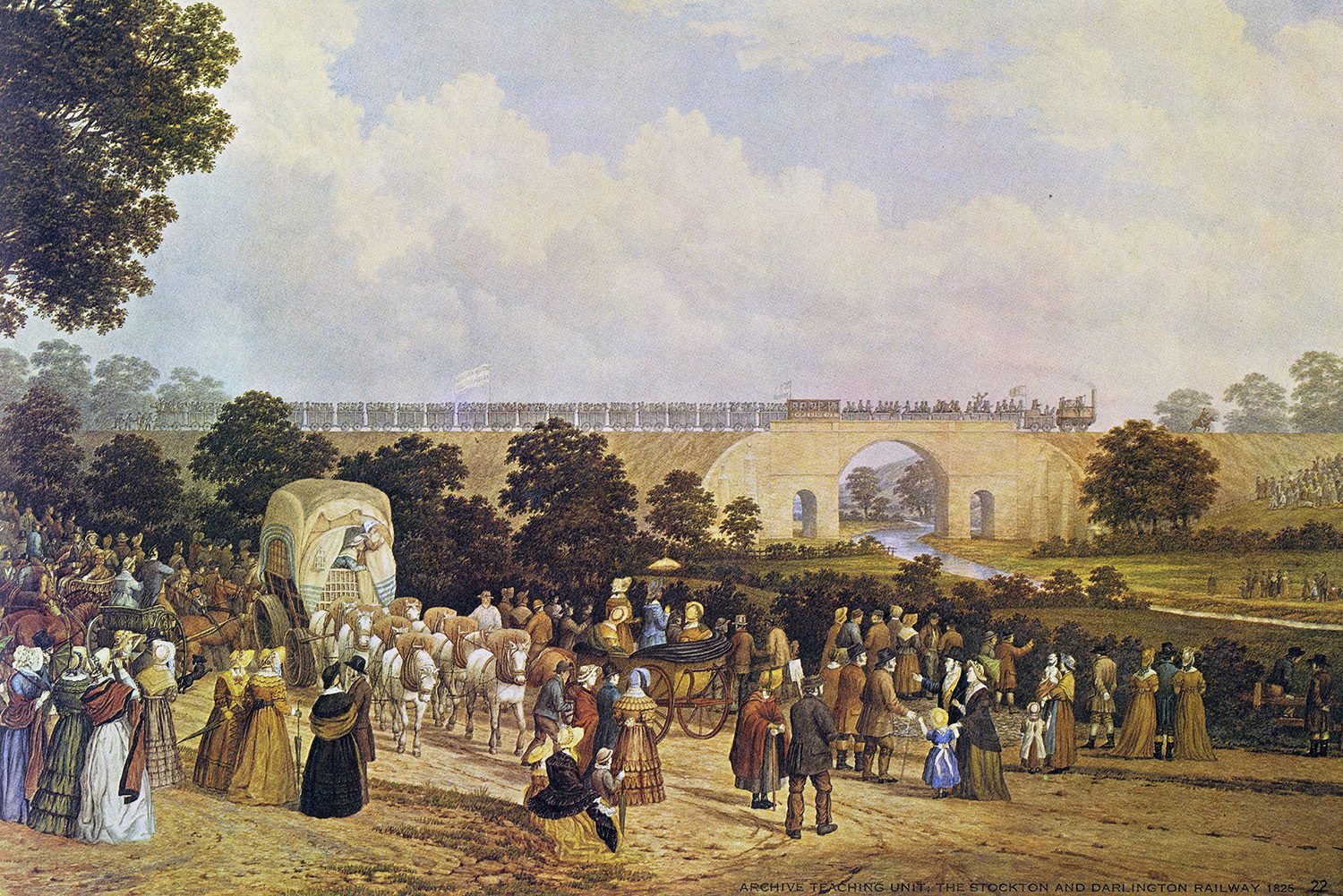
Inauguración del ferrocarril de Stockton y Darlington (1825). Óleo de John Dobbin, pintado en 1875. Fuente: National Railway Museum / Wikimedia Commons (Dominio Público)
At the start of the journey, a man on horseback rode ahead of the machine, waving a flag to warn people and carriages on nearby roads — a precautionary measure that would soon become standard practice. But when the rider moved aside, Stephenson opened the throttle and accelerated the Locomotion No. 1, leaving the horse behind, clearly demonstrating that the machine had surpassed animal power.
The journey covered about twenty-five miles (forty kilometers), and along the way, onlookers gathered to watch that fascinating iron machine pass through the landscape, with its smoking chimney, its rhythmic clatter, and the hiss of its pistons — an image and a sound that would soon become familiar and, in time, iconic.
That day, as when he had presented his Blücher, Stephenson once again astonished all who witnessed it. Aboard the Locomotion No. 1, he advanced decisively toward a technological victory that demonstrated, for the first time beyond doubt, that the railroad was a real and viable alternative for land transport.
No one in Wylam could have imagined that the boy who had once modeled steam engines out of clay would end up forging, with hands hardened in the darkness of the mines and a deeply pragmatic mindset, the system destined to change the world. It had taken him a decade to transform an experiment born in a mining environment into a functional infrastructure. And the best was still to come.
His next challenge would be the decisive one: the construction of the first intercity railroad line conceived to link a major port with an industrial city — Liverpool and Manchester. The Stockton & Darlington Railway had proven that the system worked; the Liverpool & Manchester would show how far it could go.
How did Stephenson embark on that project? Why did this line mark a turning point in the history of the railroad?
That is a story for the next stop: Liverpool & Manchester.
Global ideas, stories connected